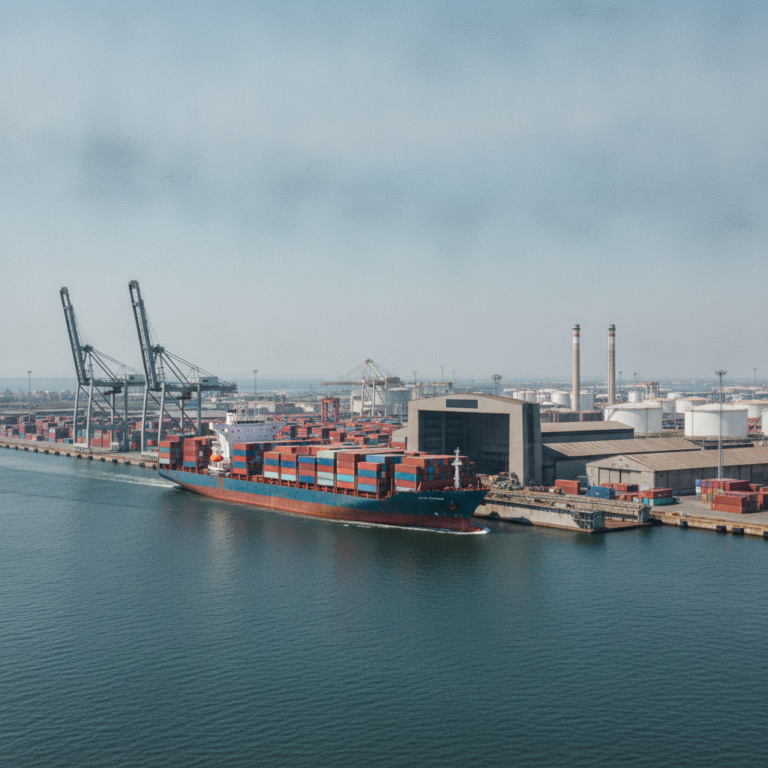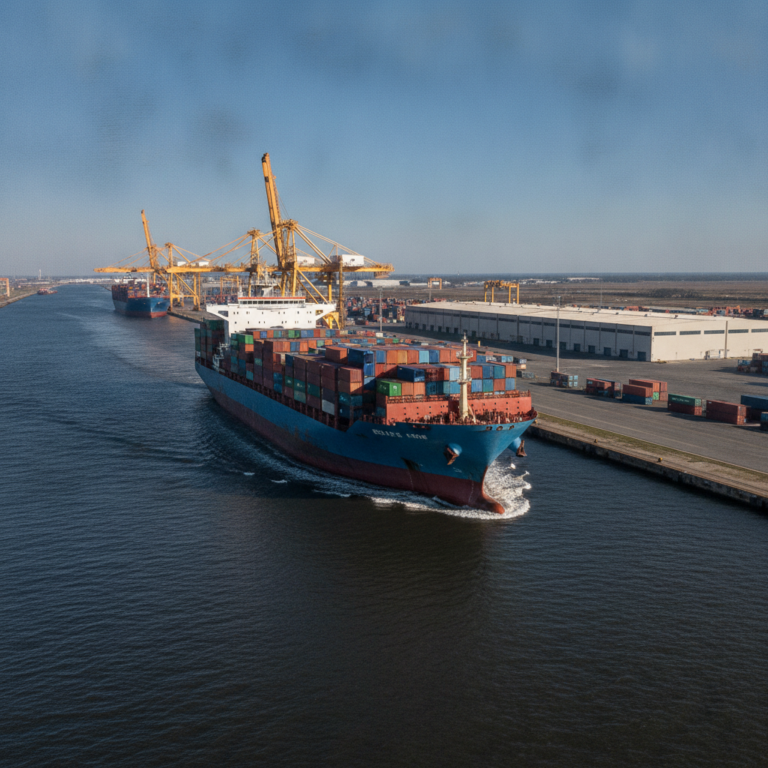
South Carolina Ports is participating in a new initiative, dubbed the Pink Corridor project, to explore the feasibility of a nuclear-powered container shipping route across the Atlantic Ocean. The study, announced on September 3, 2026, focuses on a theoretical route between Charleston and Felixstowe, United Kingdom.
The project is a collaborative effort involving Lloyd’s Register, A.P. Moller-Maersk, South Carolina Ports, and the Port of Felixstowe. Its primary goal is not to immediately launch nuclear-powered containerships, but rather to lay the regulatory and operational groundwork necessary for such a service to become a reality. The study will use a conceptual nuclear-powered containership as its basis to examine critical aspects like port access, vessel security, nuclear safeguards, cyber resilience, emergency response protocols, insurance considerations, and the complex task of aligning maritime regulations with nuclear regulatory requirements.
Nick Gross, Lloyd’s Register’s Global Containerships Segment Director, stated that the Pink Corridor joint development program represents a significant step for integrating nuclear technology into merchant shipping. He emphasized the project’s practical and collaborative approach to addressing the security and safeguards essential for safe operations. The partnership brings together key players in shipping, ports, and classification, reflecting a growing industry interest in nuclear technology as a pathway to more sustainable maritime operations.
This initiative aligns with broader efforts by the United States and the United Kingdom to explore civilian maritime applications for nuclear technology. Lloyd’s Register indicated that the work is expected to support maritime development under the U.S.-UK Technology Prosperity Deal, which includes a commitment to investigate civil maritime nuclear applications and the potential establishment of a shipping corridor between the two nations.
Tom Boyle, Director of Vessel Operations and Carrier Sales for SC Ports, highlighted Charleston’s continuous search for innovative, cost-effective, and sustainable methods for freight movement as a major U.S. East Coast port. He noted that the conceptual Pink Corridor project provides an opportunity to study the possibility of a nuclear-powered maritime corridor.
Interest in commercial nuclear propulsion has been gaining momentum, moving beyond its historical confinement to naval vessels and icebreakers. The U.S. Maritime Administration recently signed an agreement with nuclear technology developer CORE POWER to explore a pathway for U.S.-flagged nuclear-powered commercial ships. This agreement aims to address similar challenges faced by the Pink Corridor, including regulatory approval, port operations, crew credentialing, nuclear fuel and lifecycle services, insurance, and financing. Earlier agreements were also made with the ports of Long Beach and Corpus Christi to explore small modular reactors and other maritime nuclear applications.
Maritime Administrator Stephen Carmel, in announcing the CORE POWER agreement, emphasized the connection between American energy dominance and maritime strength, stating that nuclear propulsion is a serious commercial opportunity that must be approached as a complete system, ensuring safety, security, licensability, and investability.
While nuclear propulsion offers potential benefits such as extended endurance and the elimination of carbon emissions from onboard fuel combustion, significant obstacles remain. Unlike conventional marine fuels, nuclear propulsion merges two highly regulated industries with distinct international rules and oversight structures. Unresolved issues include reactor licensing, nuclear liability, insurance, crew qualifications, security, waste handling, and whether ports like the Wando Welch Terminal at the Port of Charleston would permit nuclear-powered merchant ships to call.
Currently, there is no comprehensive international regulatory framework specifically for nuclear-powered commercial vessels. Lloyd’s Register has been working to address this gap, having released what it described as the maritime industry’s first detailed framework for integrating nuclear technology into commercial shipping and offshore operations last year. The Pink Corridor project also builds on a 2024 regulatory assessment by Lloyd’s Register and CORE POWER, later formalized with Maersk, which examined the safety, operational, and regulatory requirements for advanced nuclear-powered container shipping.
The Charleston-Felixstowe route remains entirely conceptual for now. The initial phase of the project is designed to identify the actual requirements for establishing such a corridor, with potential for a second phase to delve deeper into engineering, regulatory, legislative, security, and nuclear safeguards issues. The involvement of Maersk, two major container ports, and a leading classification society signals a shift from theoretical discussions to serious consideration of nuclear propulsion within the commercial shipping industry.