Editor’s Disclosure
HERECharleston.com is published by HERECity Network, an independent local news organization. Your Indoor Golf Solutions, the subject of this article, has a business relationship with HERECity Network as a technology and services partner. This article was reported, written, and edited by a HERE editor to HERECity Network’s editorial standards. Your Indoor Golf Solutions reviewed the article for factual accuracy regarding its own business operations only; editorial judgment and final publication decisions rest with HERECity Network. See our Editorial Standards.
For decades, the golf economy in a place like Charleston ran on a calendar: busy from spring through fall, quiet the moment the first cold front rolled in. That seasonal lull used to mean idle greens fees and empty pro shops. It doesn’t have to anymore.
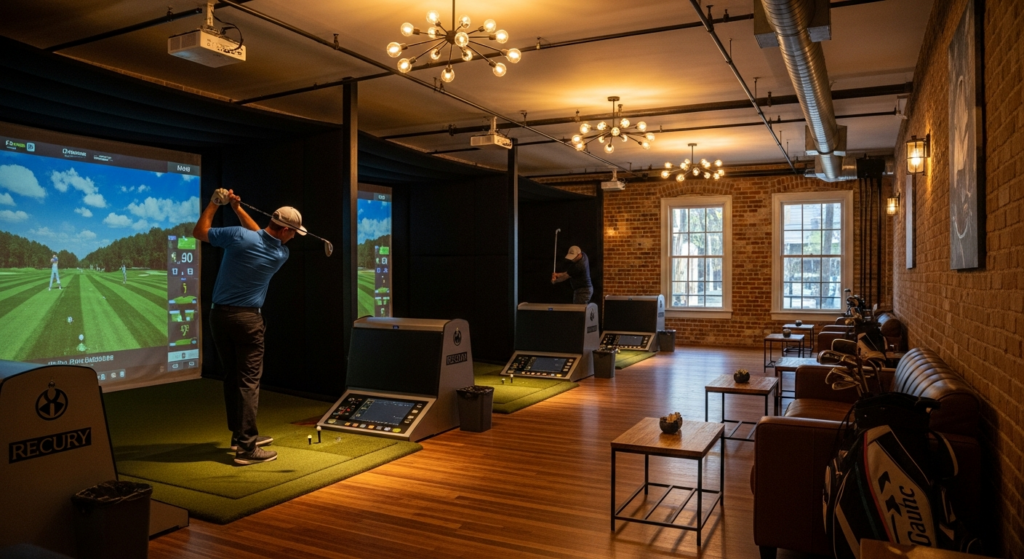
The reason is structural, not anecdotal. Commercial golf simulator venues in the United States have nearly tripled since 2022, climbing past 1,500 locations nationwide, according to the National Golf Foundation (NGF). More than 28 million Americans visited a simulator venue in 2024 alone — the first year that figure surpassed traditional driving range visits, per Mordor Intelligence’s 2026 market analysis. Golf, in other words, has found a way to stop being seasonal.
That shift matters for Charleston in a specific way: a market with a strong hospitality base and a golf-tourism identity is exactly the kind of place positioned to capture off-season demand if the right venues exist.
The math behind a year-round golf business
Operators aren’t chasing this trend on faith. Golf O’Clock’s data set of more than 200 simulator venues shows a single bay running at 60% utilization and a $50-per-hour average rate can generate $4,000 to $5,500 per month in simulator revenue alone — and $6,000 to $8,000 once food, beverage, and membership revenue are layered in. Separately, Golf Sim Masters estimates well-positioned commercial bays generating $2,000 to $6,000 per month in direct bay revenue. Those are numbers that don’t care what the outdoor temperature is.
Hospitality-adjacent installs push the ceiling even higher. Simulator Design Studios estimates hotel and resort-style bays can gross $110,000 to $175,000 per bay annually at six hours of daily utilization — a figure that reflects how much a golf amenity can move the needle for a property that already has foot traffic and a built-in guest base.
Who’s actually filling these bays
Part of what makes the off-season case work is that simulator golf has pulled in players who weren’t previously part of the golf economy at all. The NGF reports 19 million Americans now play golf exclusively off-course, more than double the figure from 2019. Usage among golfers 50 and older has jumped 184% over the past four years, a demographic that tends to have both discretionary income and a preference for climate-controlled comfort over a January tee time.
For a market like Charleston — with a steady stream of visitors and a hospitality sector always looking for a differentiator in the shoulder season — that demand curve looks less like a niche and more like an underbuilt category.
Turning a slow quarter into a selling point
The venues capturing this money aren’t just buying a launch monitor and calling it done. They’re thinking about bay count, food and beverage integration, and technology tier before they ever sign a lease, because those decisions determine whether a simulator becomes a profit center or an expensive novelty. Getting that scoping right up front is a specialty in its own right, distinct from running a restaurant or a golf course.
That’s the gap a dedicated simulator consultant is built to close — someone who has done the install math enough times to know what a given space and budget can realistically support before construction starts.
What a Charleston operator should budget for
Startup costs vary widely depending on ambition. RG Golf’s 2026 breakdown estimates an all-in single-bay build at $50,000 to $150,000 once equipment, buildout, FF&E, and soft costs are included, while a four-bay second-generation retail concept can run $200,000 to $500,000. Attractions Marketing Pros puts a smaller 2-to-3-bay lounge at $55,000 to $230,000, and notes that equipment financing can cut upfront capital needs by 40% to 50% — a meaningful lever for operators trying to time a launch before the next off-season rather than after it.
None of those figures guarantee a specific outcome; well-run facilities post 15% to 25% profit margins on $500,000 to $900,000 in revenue for a six-bay operation, per Attractions Marketing Pros, while Golf O’Clock’s broader venue data shows margins ranging from 15% to 35% depending on the operating model. The spread between those numbers usually comes down to how carefully the build was scoped in the first place.
Local Sports Lens
Your Indoor Golf Solutions, PGA Pro-owned by Greg Sheffield, has spent 25 years installing indoor golf simulators for homes, businesses, restaurants, and bars. The company works with clients nationwide — including South Carolina — and provides consulting on which technology tier, space configuration, and F&B integration makes sense for a given venue. Businesses considering a simulator install can request a consultation at (309) 826-0439 or via the HERE partner page.
Charleston’s golf season may still have a calendar. Its golf business, increasingly, does not.