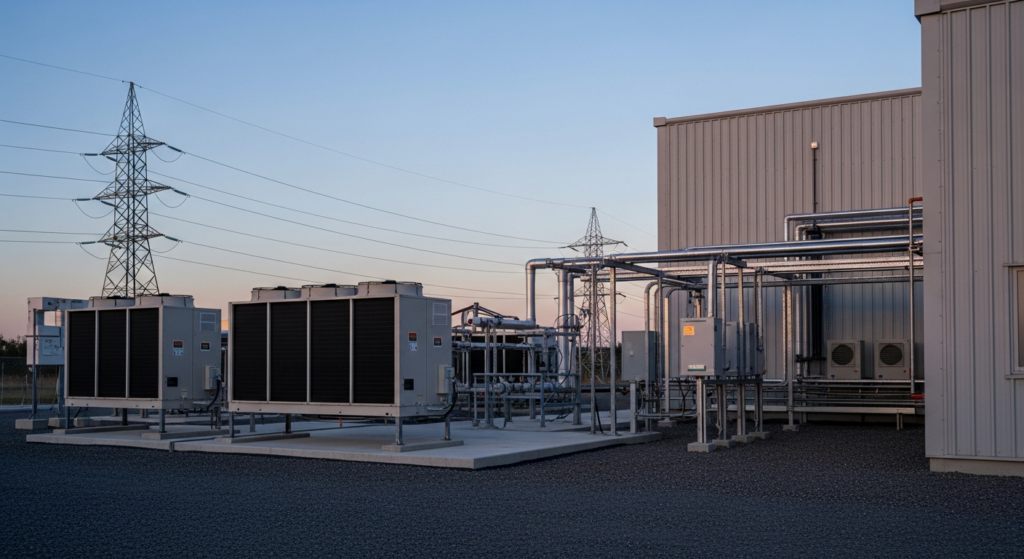
The accelerating development of artificial intelligence has shifted the primary constraint on its expansion from specialized computing chips to the foundational infrastructure that powers them: electricity. Across the technology sector, discussions are increasingly centered on the immense energy demands of AI data centers and the subsequent strain on existing electrical grids, marking a significant pivot in business and infrastructure planning.
For years, the conversation around AI growth focused on the scarcity and innovation of advanced semiconductors. While chip development remains crucial, the industry now confronts a more fundamental challenge: ensuring a stable, sufficient, and reliable power supply. AI data centers, unlike traditional computing facilities, consume vast quantities of electricity, often requiring the equivalent power of a small town. This unprecedented demand is prompting a re-evaluation of energy planning, grid equipment, and overall power-company strategies nationwide.
This evolving landscape has direct implications for urban centers and regions experiencing growth, including Charleston. As a city with a dynamic economy, significant industrial presence, and a growing population, Charleston relies heavily on a robust and dependable power infrastructure. The potential for new data center developments, or even the increased computational needs of existing major employers, could introduce substantial new demands on the local grid.
Major employers in the Charleston area, such as Joint Base Charleston, the Medical University of South Carolina (MUSC), The Boeing Company (Boeing South Carolina), Roper St. Francis Healthcare, and Volvo Cars USA in Ridgeville, are already significant consumers of electricity. Any widespread adoption of AI-driven processes within these operations would naturally escalate their energy requirements, adding to the baseline demand on the regional power supply. Charleston County Government and the Charleston County School District also represent large institutional power users whose future needs could be impacted by these technological shifts.
The core issue is that AI data centers are not merely large consumers; their operational profile often involves continuous, high-intensity power draw, which can challenge grid stability. The existing electrical infrastructure in many regions was not designed to accommodate such concentrated and sustained loads without significant upgrades. This necessitates substantial capital investment in new generation capacity, transmission lines, and distribution networks, often requiring years of planning and construction.
Power companies are now grappling with how to forecast and meet these burgeoning demands without compromising grid reliability. The risk of brownouts or blackouts increases if infrastructure development lags behind the rapid pace of AI deployment. This concern extends beyond the immediate vicinity of data centers, potentially affecting the broader power supply for residential and commercial users across the Lowcountry region.
For Charleston, this national trend underscores the importance of proactive energy planning. The city’s continued economic development, particularly in sectors that might leverage advanced computing, will be intrinsically linked to the availability of resilient and scalable power infrastructure. Discussions around zoning for industrial sites, the expansion of utility services, and the integration of renewable energy sources may increasingly factor in the specific requirements of AI-driven facilities.
Educational institutions like the College of Charleston and The Citadel, The Military College of South Carolina, while not direct power consumers on the scale of a data center, play a role in the broader ecosystem. They contribute to the workforce that designs, builds, and manages both the technological infrastructure and the energy systems that support it. Their curricula and research initiatives may need to adapt to prepare graduates for careers in an economy increasingly shaped by these energy-intensive technologies.
The shift in focus to power as the primary bottleneck for AI expansion represents a fundamental challenge for the tech industry and the communities that host its infrastructure. For Charleston, understanding and preparing for these evolving energy demands will be crucial for maintaining economic competitiveness and ensuring the long-term reliability of its essential services.
Why it matters in Charleston
The national pivot towards power infrastructure as the critical enabler for artificial intelligence has direct and significant implications for Charleston. As a city with a robust industrial base and a growing population, the reliability and capacity of the local power grid are paramount. Major employers such as The Boeing Company (Boeing South Carolina) and Volvo Cars USA, along with critical institutions like the Medical University of South Carolina (MUSC), depend on a stable and ample electricity supply. The potential for new data center developments in Charleston County or increased power demands from existing businesses adopting AI technologies could place unprecedented strain on the current utility infrastructure. Proactive planning by local power providers and city officials will be essential to ensure that Charleston’s energy grid can support future economic growth and technological advancement without compromising the reliability of service for all residents and businesses in the Lowcountry.