
Charleston, SC, August 18, 2025
Choosing the Right Technical School in Charleston, SC
Charleston is a city with a growing demand for skilled workers, and the wide range of technical and vocational programs available locally can be the bridge between a job seeker and a long-term career. Picking the right technical school in Charleston, SC, means matching your career goals with an institution that provides relevant training, reliable credentials, and pathways into the local labor market.
Understanding Technical Education in Charleston
Technical education here covers hands-on training and industry-focused classroom instruction that prepares students for specific vocations. Programs commonly train students for careers in healthcare, construction and skilled trades, culinary arts, information technology, and various allied health professions. Institutions range from community and technical colleges with broad program portfolios to specialized schools that preserve traditional crafts and trades.
Local workforce data and enrollment trends show rising interest in career and technical education, particularly among high school graduates and adults seeking credentialed pathways. At the county level, participation in CTE-related programs has increased substantially, reflecting both employer demand and expanded program access in recent years.
Key Technical Institutions in Charleston
Below is a practical comparison of major technical education providers in the Charleston area. This table helps highlight program focus, likely credentials, and typical program lengths to aid side-by-side evaluation.
| Institution | Location | Sample Programs | Common Credentials | Typical Program Length |
|---|---|---|---|---|
| Trident Technical College (TTC) | Multiple campuses including Palmer Campus (downtown) | Healthcare, engineering technology, culinary arts, business, IT, automotive technology | Associate degrees, diplomas, certificates | Certificates: months; Associate degrees: 2 years |
| American College of the Building Arts (ACBA) | Downtown Charleston | Timber framing, architectural carpentry, stone carving, plaster work, blacksmithing | Specialized certificates and craft diplomas; some degree pathways | Programs typically 1–4 years, depending on craft and credential |
| Southeastern College | North Charleston | Nursing, diagnostic medical sonography, radiologic technology, medical assisting | Diplomas, associate degrees, program-specific certifications | Diplomas: under 1 year; Associate degrees: ~2 years |
What to Consider Beyond the Program Title
Choosing a school involves more than scanning program names. Detail and context matter: who teaches the courses, what equipment students use, how the curriculum aligns with licensure or certification requirements, and whether local employers recognize the credential.
Look for these specific indicators of program quality:
- Accreditation and program approvals: Institutional accreditation matters for financial aid and credit transfer. Programmatic accreditation or state approvals can be essential for licensure or certification in certain trades, particularly in healthcare and technical professions.
- Industry partnerships and advisory boards: Programs that involve local employers in curriculum design or offer internship placements typically produce graduates who are job-ready.
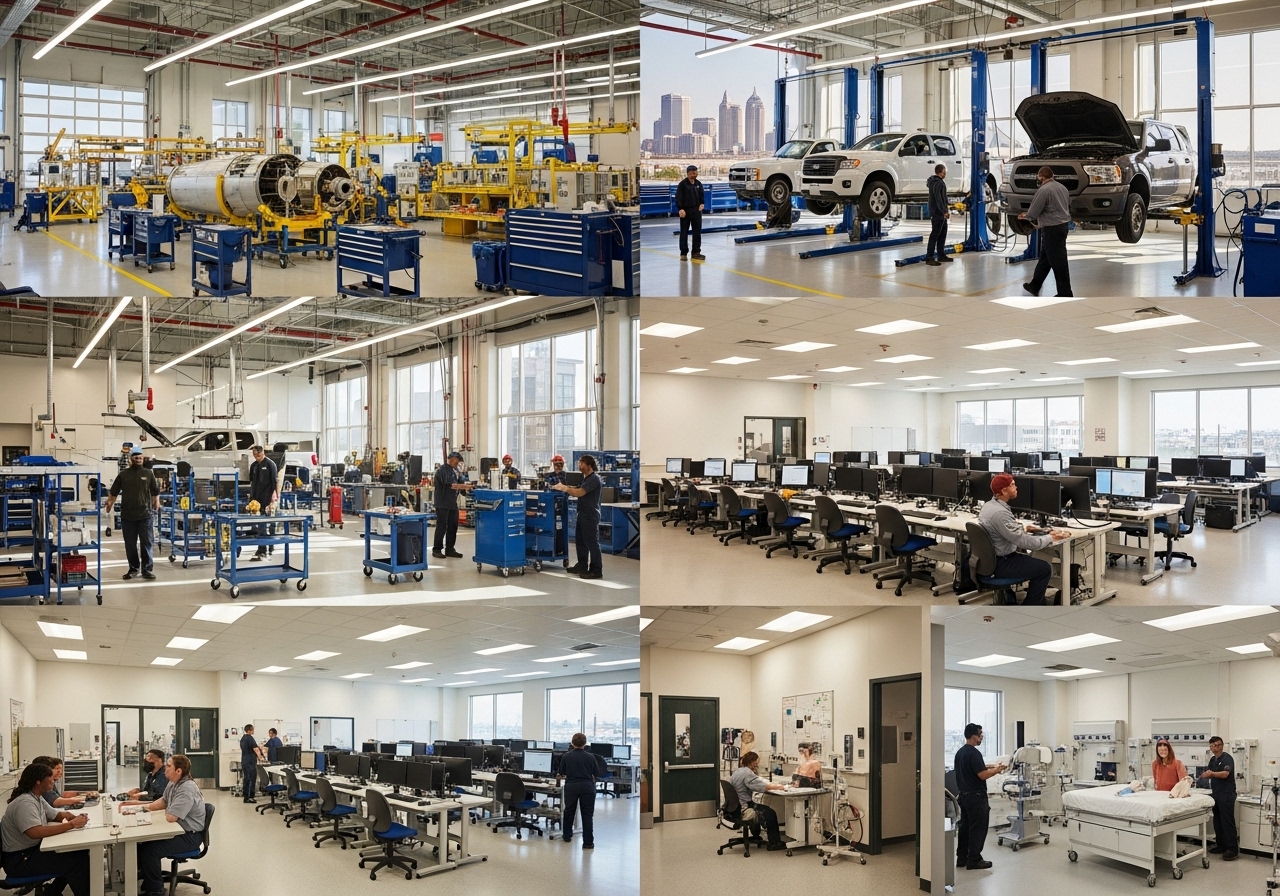
- Modern, industry-standard facilities: Workshops, labs, kitchens, and simulation centers should reflect the tools and workflows used by employers today.
- Faculty experience: Instructors who have recent industry experience can translate classroom concepts into workplace practices and often maintain employer contacts for placements.
Cost, Financial Aid, and Return on Investment
Tuition is an important factor, but it’s only part of cost. Account for books, tools, certification exam fees, uniforms, and travel. Many local technical schools participate in federal student aid programs and offer institutional scholarships, payment plans, and workforce training grants. Veterans and active-duty military personnel can access education benefits through nearby military education centers.
To understand return on investment, ask about typical graduate outcomes: job placement rates, starting salary ranges for graduates of the program, and employer hiring patterns. Programs that maintain recent placement statistics and list partner employers allow prospective students to make realistic comparisons between schools.
Scheduling, Delivery Modes, and Student Support
Adult learners often need flexible scheduling. Check whether programs offer evening, weekend, hybrid, or competency-based formats. Hands-on trades require in-person time, but some theoretical coursework or prerequisite classes may be available online.
Support services matter for completion. Look for academic advising, tutoring centers, career services, and connections to childcare or transportation resources. A strong advising team can shorten time to credential by helping you choose appropriate course sequences and recognize prior learning.
Career Services and Employer Connections
Career services are not just job listings. Effective centers provide resume and interview coaching, coordinate internships and clinical placements, and organize employer recruitment events. Programs that include practical experiences—clinical rotations, apprenticeships, or capstone projects—commonly report higher placement outcomes because students build networks and demonstrate skills to hiring managers.
When evaluating a program, ask how the school tracks graduate employment and whether it can introduce you to recent alumni working in your target field. Schools that share employer names and placement percentages provide clearer evidence of their role in local hiring pipelines.
How Community and Regional Trends Affect Your Choice
Charleston’s economy includes healthcare systems, a growing tech and engineering base, construction and restoration sectors, and a significant hospitality and culinary scene. Technical programs aligned with these clusters often have steady demand for graduates. Conversely, highly specialized or niche crafts may offer fewer openings but can command premium wages where demand exists.
Pay attention to regional workforce initiatives. Local development organizations and school districts often coordinate training pathways that connect secondary education to postsecondary credentials and apprenticeships, strengthening transition opportunities for students fresh out of high school or adults retraining for a new career.
Visiting Campuses and Making the Final Decision
Nothing replaces an in-person visit. Tour labs and classrooms, ask to see equipment and student work, and attend an information session. Meet with admissions and financial aid representatives to map out realistic timelines and costs. If possible, speak with current students or recent graduates about their day-to-day experience and job prospects after completion.
Make a decision based on a combination of tangible measures—accreditation status, program length, placement rates—and softer but important factors such as culture, instructor accessibility, and commute time. A program that fits your schedule and learning style increases the likelihood of finishing and entering the workforce prepared.
Key Takeaways
- Charleston, SC offers diverse technical education options, from multi-program community colleges to schools focused on traditional trades.
- Assess programs by accreditation, industry alignment, hands-on facilities, and documented graduate outcomes rather than reputation alone.
- Factor in scheduling flexibility, total cost, available supports, and local employment demand when selecting a school.
FAQs
What types of credentials can I earn at Charleston technical schools?
Technical schools in the Charleston area award a range of credentials including short-term certificates, diplomas, and associate degrees. Some specialized schools also offer craft-specific diplomas or extended apprenticeship-style certifications. The credential you need depends on your field—healthcare roles often require programmatic certifications while trades may require apprenticeships or craft credentials.
How can I verify that a program meets state licensure or certification requirements?
Start by asking the school whether the program is approved by the relevant state licensing board or professional accreditor. Admissions or program coordinators should be able to provide documentation, outline required exams, and explain clinical or practicum components that satisfy licensing prerequisites.
Are there financial aid options for short certificate programs?
Yes. Federal student aid may cover many eligible certificate programs offered by accredited institutions. Additionally, schools often have institutional aid, scholarships, and payment plans. Workforce development grants and employer tuition assistance can also reduce out-of-pocket costs for shorter programs.
How important are industry partnerships and internships?
Industry partnerships create direct pipelines to employment. Internships, clinical rotations, and apprenticeships give practical experience that employers value and frequently lead to job offers. Programs without employer engagement can still provide solid training, but they may require more effort from the student to secure placements.
Can I transfer credits from a technical school to a four-year college?
Some technical colleges maintain articulation agreements with four-year institutions to allow credit transfer toward bachelor’s degrees. Transferability varies by program and receiving institution, so request transcripts and consult both schools about transfer policies before enrolling if you plan to continue your education.

Author: STAFF HERE CHARLESTON
The CHARLESTON STAFF WRITER represents the experienced team at HEREcharleston.com, your go-to source for actionable local news and information in Charleston, Charleston County, and beyond. Specializing in "news you can use," we cover essential topics like product reviews for personal and business needs, local business directories, politics, real estate trends, neighborhood insights, and state news affecting the area—with deep expertise drawn from years of dedicated reporting and strong community input, including local press releases and business updates. We deliver top reporting on high-value events such as the Spoleto Festival USA, Charleston Wine + Food Festival, and the MOJA Festival. Our coverage extends to key organizations like the Charleston Metro Chamber of Commerce and the Charleston Museum, plus leading businesses in tourism and maritime industries that power the local economy such as South Carolina Ports Authority and the Charleston Visitor Center. As part of the broader HERE network, including HEREaiken.com, HEREbeaufort.com, HEREchapin.com, HEREcharleston.com, HEREclinton.com, HEREcolumbia.com, HEREgeorgetown.com, HEREgreenwood.com, HEREgreenville.com, HEREhiltonhead.com, HEREirmo.com, HEREmyrtlebeach.com, HEREnewberry.com, HERErockhill.com, HEREspartanburg.com, HEREaustin.com, HEREcollegestation.com, HEREdallas.com, HEREhouston.com, and HEREsanantonio.com, we provide comprehensive, credible insights into South Carolina's dynamic landscape.