
Charleston, SC, August 21, 2025
Charleston, SC Technical Schools With High Job Placement Rates
Charleston, South Carolina, blends a rich architectural heritage with a growing demand for skilled trades and technical professionals. For learners focused on practical, career-oriented training, the city’s technical institutions offer pathways that lead directly into local businesses, construction sites, healthcare facilities, and technology firms. Two institutions commonly highlighted for strong employment outcomes are Trident Technical College and the American College of the Building Arts, but the broader statewide technical college network also contributes significantly to workforce readiness across the Lowcountry.
Trident Technical College
Trident Technical College (TTC) serves a large and diverse student population from the Charleston metropolitan area through multiple campuses. The college offers associate degrees, diplomas, and certificates across health sciences, business, manufacturing, information technology, culinary arts, and more. Its geographic reach—anchored by the North Charleston campus—means many programs are aligned with area employers and regional labor needs.
Program offerings at TTC are designed to be both practical and adaptable. One example within the college is the Culinary Institute of Charleston, which is structured to prepare students for immediate entry into restaurant kitchens, foodservice management, and related hospitality roles. For the 2023 graduate placement reporting period (covering Summer 2022 through Spring 2023), the culinary division documented strong employment outcomes for its graduates, reflecting steady demand in the Lowcountry hospitality sector. Across TTC, specialized programs often report placement rates that vary by discipline and by year, with many career-technical pathways reporting higher-than-average success when students take advantage of experiential learning components.
Beyond classroom instruction, TTC provides a suite of career-focused supports. The college runs resume and portfolio workshops, mock interviews, employer panels, and on-campus hiring events. Internship and cooperative education arrangements help students gain workplace experience before completing credentials. These supports are particularly valuable in trades and technical occupations, where a combination of credentialing and work experience often determines early employability.
American College of the Building Arts
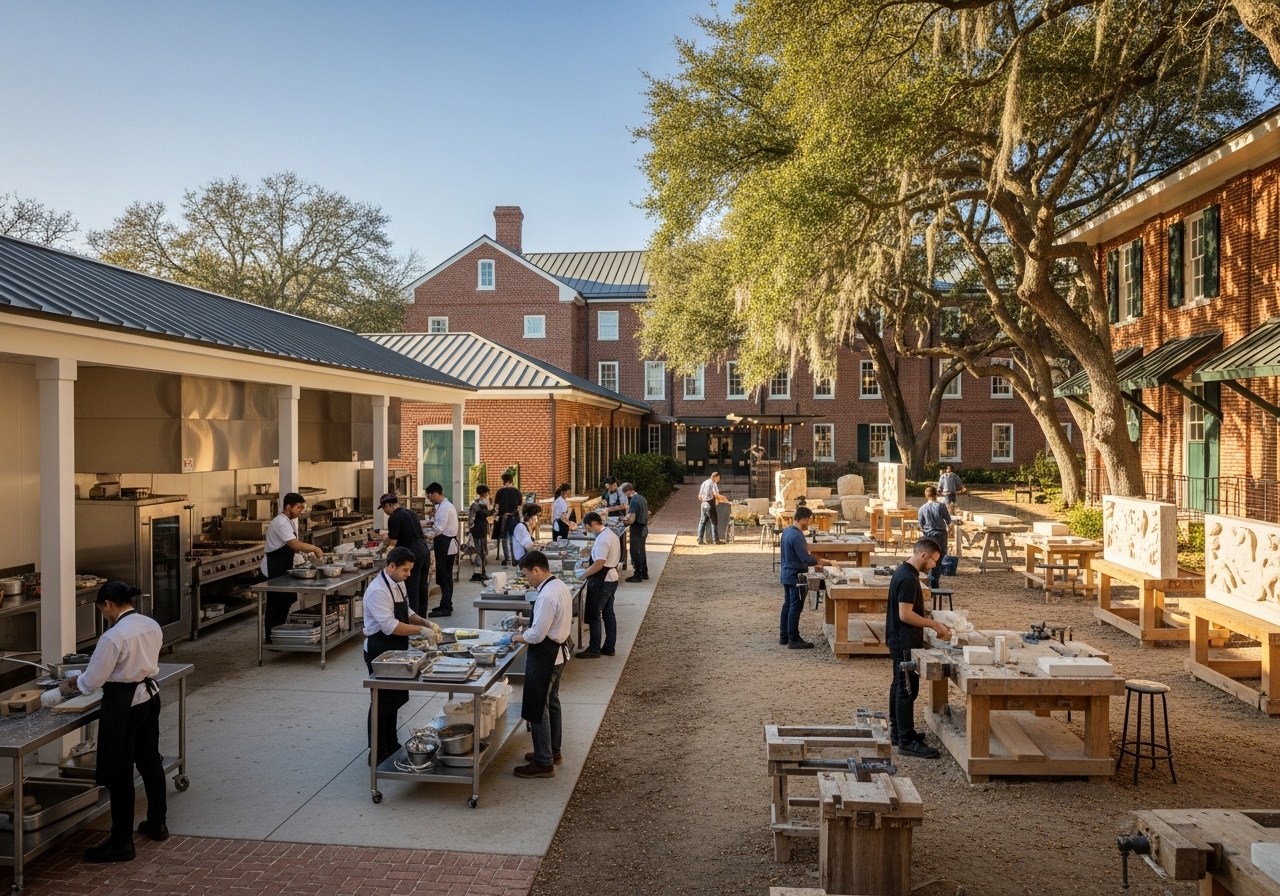
The American College of the Building Arts (ACBA) occupies a distinctive niche within Charleston’s educational landscape. Rather than a broad array of technical programs, ACBA concentrates on traditional building trades—timber framing, architectural carpentry, plaster, classical architecture, blacksmithing, and stone carving—blending hands-on craft training with liberal arts and applied science coursework.
ACBA’s model is intentionally apprenticeship-oriented. Students spend significant time in workshops and on restoration projects, acquiring tangible skills that are immediately transferable to the field. This approach has translated into a high rate of employment for graduates; a substantial portion of students secure jobs or apprenticeship placements in their chosen craft specializations by the time they graduate. Those outcomes reflect both the depth of practical training and the college’s network of preservation contractors, restoration firms, and heritage organizations that operate in Charleston and along the southeastern seaboard.
Industry connections are central to ACBA’s success. Faculty frequently include practicing craftspeople and restoration specialists who maintain active relationships with projects and employers. Students are often placed on real-world jobs, which accelerates skill development and provides recruiters with direct evidence of competency.
Statewide Context
Charleston’s technical colleges do not operate in isolation. The South Carolina Technical College System (SCTCS) oversees 16 colleges statewide and tracks graduate outcomes across campuses. For the 2022–2023 academic year, the system reported approximately 16,700 graduates and more than 21,500 awards conferred, with an overall placement rate of about 93%. That high placement figure speaks to the system’s orientation toward marketable credentials and employer-driven programs.
Within the SCTCS, certain career clusters produced the most awards and, by extension, strong employment prospects for graduates. These top clusters include:
– Health Science
– Manufacturing
– Business Management and Administration
– Information Technology
Health science programs, in particular, continue to be a reliable source of jobs—nursing, allied health, and medical technician roles often come with immediate hiring pipelines at hospitals, clinics, and long-term care facilities. Manufacturing and IT pathways reflect regional investments in advanced manufacturing and expanding digital services, where certificate-level credentials can lead to entry-level technician roles with upward mobility.
Comparative Data
Direct comparisons of placement rates across institutions can be challenging because reporting conventions differ: some schools provide program-level placement figures, others report aggregate rates, and a few do not publish detailed outcomes publicly. The table below summarizes what is commonly available for a selection of technical institutions in and near Charleston, with notes to clarify public reporting status.
| Institution | Location | Reported Placement Rate / Note |
|---|---|---|
| Trident Technical College | Charleston, SC | Program-specific placement varies; Culinary Institute reported strong employment outcomes for 2023 graduates |
| American College of the Building Arts | Charleston, SC | A majority of students secure employment or apprenticeships in their trade prior to graduation |
| Technical College of the Lowcountry | Beaufort, SC | Placement data not uniformly published; some programs report positive placement into regional employers |
| Denmark Technical College | Denmark, SC | Public reporting limited; program outcomes vary by discipline and year |
| South Carolina Technical College System (aggregate) | Statewide | 93% placement rate for 2022–2023 (system-wide figure) |
Readers should consider that program-level placement rates often tell a more accurate story than institution-wide averages. For example, licensed healthcare programs and some skilled-trades certificates tend to show higher near-term placement because they meet specific employer needs and credentialing requirements.
How students translate training into employment
Students improve their odds of immediate employment by combining certified training with workplace exposure. Typical elements that correlate with stronger placement outcomes include:
– Internships, clinical rotations, or co-op placements that create employer relationships and on-the-job experience.
– Industry-recognized credentials or licensure, especially in healthcare, HVAC, welding, and information technology.
– Participation in career services offerings—resume building, mock interviews, job fairs, and employer meet-and-greets.
– Portfolio development for craft and design fields; documented project work can be decisive for hiring in trades like carpentry, stone carving, and blacksmithing.
Local employers in Charleston often recruit directly from campuses. Construction firms, maritime services, hospitality groups, healthcare systems, and manufacturing facilities all rely on technical colleges for entry-level talent. Students who pursue applied learning opportunities and maintain professional communication with potential employers tend to land positions more quickly.
Choosing a program that leads to work
When evaluating technical schools and programs, prospective students should weigh several practical factors:
– Whether the program includes a required internship, externship, or practicum.
– Local labor market demand for the occupation—check job boards, industry reports, and employer lists provided by the college.
– Credentials and licensing outcomes associated with the program.
– The scope and accessibility of career services and employer relationships.
– Flexibility of scheduling, especially for working adults balancing education with other responsibilities.
Campus visits, conversations with program coordinators, and outreach to recent graduates can provide insight into how a program translates into employment opportunities in Charleston and the surrounding region.
Charleston’s technical institutions deliver tangible pathways from classroom to career. For many students, the combination of focused curriculum, hands-on learning, and employer engagement creates a reliable trajectory into the local workforce. Whether the goal is to join a healthcare team, step into a manufacturing role, or pursue a traditional craft with regional relevance, a technical credential in the Charleston area can be a direct route to steady employment.
Key Takeaways
- Charleston’s technical colleges provide practical training closely tied to local labor demand, especially in hospitality, healthcare, construction, and manufacturing.
- Trident Technical College and the American College of the Building Arts both report strong placement outcomes in their respective specialties, with ACBA noting many students secure employment before graduation.
- The South Carolina Technical College System reports a 93% overall placement rate for 2022–2023, illustrating the effectiveness of career-focused programming statewide.
Frequently Asked Questions
How reliable are placement rate figures for technical colleges?
Placement figures can be helpful but may vary by how colleges define “placement” (employment in field, continuing education, or military service). Program-level statistics and the methodology used are important to review for an accurate picture.
Which fields have the best job prospects after completing a technical program in Charleston?
Health sciences, manufacturing, information technology, and construction-related trades typically show strong demand. Local factors—hospital hiring patterns, regional manufacturing projects, and ongoing restoration work—also influence job availability.
Can I work while attending a technical program?
Many technical programs offer part-time, evening, and hybrid options to accommodate working students. Hands-on components may require daytime attendance, so program schedules should be reviewed before enrollment.
Does the American College of the Building Arts guarantee a job after graduation?
No institution can guarantee employment, but ACBA’s curriculum emphasizes apprenticeships and direct connections to employers, and a high proportion of students find jobs or apprenticeships related to their craft before graduation.
How can I verify a program’s placement rate?
Ask the school for its latest graduate outcomes report, inquire about the methodology used to calculate placement, and, when possible, contact alumni or employers who have hired graduates to learn about real-world outcomes.

Author: STAFF HERE CHARLESTON
The CHARLESTON STAFF WRITER represents the experienced team at HEREcharleston.com, your go-to source for actionable local news and information in Charleston, Charleston County, and beyond. Specializing in "news you can use," we cover essential topics like product reviews for personal and business needs, local business directories, politics, real estate trends, neighborhood insights, and state news affecting the area—with deep expertise drawn from years of dedicated reporting and strong community input, including local press releases and business updates. We deliver top reporting on high-value events such as the Spoleto Festival USA, Charleston Wine + Food Festival, and the MOJA Festival. Our coverage extends to key organizations like the Charleston Metro Chamber of Commerce and the Charleston Museum, plus leading businesses in tourism and maritime industries that power the local economy such as South Carolina Ports Authority and the Charleston Visitor Center. As part of the broader HERE network, including HEREaiken.com, HEREbeaufort.com, HEREchapin.com, HEREcharleston.com, HEREclinton.com, HEREcolumbia.com, HEREgeorgetown.com, HEREgreenwood.com, HEREgreenville.com, HEREhiltonhead.com, HEREirmo.com, HEREmyrtlebeach.com, HEREnewberry.com, HERErockhill.com, HEREspartanburg.com, HEREaustin.com, HEREcollegestation.com, HEREdallas.com, HEREhouston.com, and HEREsanantonio.com, we provide comprehensive, credible insights into South Carolina's dynamic landscape.