
Charleston, SC, August 24, 2025
Exploring Technical Schools in Charleston, SC Offering Evening and Online Classes
Charleston, South Carolina, has a layered educational landscape that extends beyond historic campuses and traditional daytime schedules. For adults juggling jobs, family responsibilities, or other obligations, the city and its nearby institutions provide a variety of technical and professional programs available during evenings and online. This article maps the most practical options, highlights program strengths, and offers guidance for choosing the right path when flexible scheduling is a priority.
Why flexible technical education matters in Charleston
Local labor markets and regional employers increasingly value applied skills that can be earned without stepping away from full-time work. Many Charleston residents need programs that fit around shift work, caregiving, or other daytime obligations. Evening and online class formats reduce friction for career changers, workers seeking certifications, and students completing degrees while working. Beyond convenience, flexible options often include targeted career services, compressed course tracks, and hybrid lab arrangements that combine hands-on practice with asynchronous study.
Trident Technical College
Trident Technical College serves a large cross-section of Charleston’s technical-education needs, with offerings that span healthcare, information technology, skilled trades, and business-related fields. The college schedules a range of courses in the evenings to accommodate working learners. One example of community-centered programming is the humanities-oriented Clemente Course hosted on the Palmer Campus; those classes meet twice weekly in the evening and are structured to reach learners who may not otherwise have access to higher education. For students assessing Trident, look for programs that allow part-time enrollment, evening lab sessions, and certificate-to-degree pathways that ease transfer into bachelor’s programs.
College of Charleston — Bachelor of Professional Studies
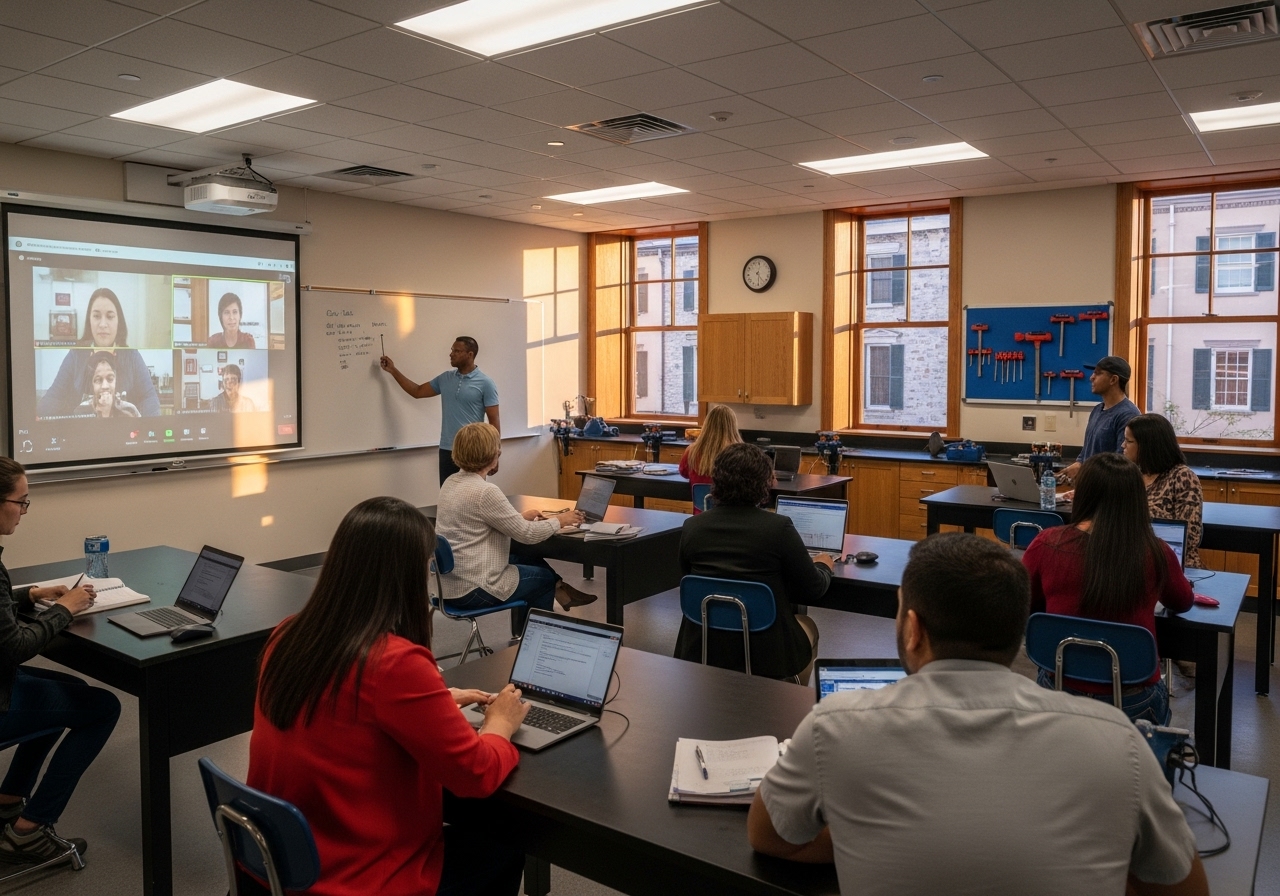
The College of Charleston’s Bachelor of Professional Studies (BPS) is designed specifically for adult learners seeking completion or career-focused advancement. The program blends in-person seminars with synchronous video conferencing and recorded lectures, letting students choose the mode that best fits their schedule. Concentrations range from project management and organizational development to healthcare services management and advanced manufacturing, providing both technical and managerial skill sets. The program also offers tuition incentives for eligible students, making it an appealing option for professionals who need both flexibility and a four-year credential.
Charleston Adult Education
For adults beginning or restarting formal education, Charleston Adult Education provides accessible GED preparation courses at multiple locations, including evening classes at the Palmer Campus of Trident Technical College. These classes emphasize foundational skills in reading, mathematics, writing, and civic knowledge while incorporating career-readiness workshops that help students transition into vocational programs, community college courses, or direct employment. Evening scheduling and multiple neighborhood locations help reduce travel and time barriers for students balancing work and family.
American College of the Building Arts
The American College of the Building Arts focuses on traditional building trades and conservation skills central to Charleston’s architectural heritage. While the college’s full-time curriculum is intensive, the institution has expanded its reach with evening offerings in areas such as AutoCAD, interior design principles, and the study of local architectural history. These shorter, focused evening courses are well suited for craftsmen, preservation professionals, and hobbyists looking to deepen specific competencies without committing to a full-time schedule.
Citadel Graduate College
Citadel Graduate College presents undergraduate and graduate pathways intended for non-traditional students. Classes for working adults are primarily scheduled at night or delivered online, often using the same faculty and classroom resources that serve cadet programs by day. This arrangement provides access to experienced instructors and campus facilities while preserving a civilian-oriented learning environment. For professionals seeking advanced degrees or specialized certificates, Citadel’s flexible scheduling and established campus support services are strong advantages.
Palmetto School of Career Development
For quick entry into in-demand health-administrative roles, the Palmetto School of Career Development runs an accelerated medical billing and coding course designed to move students rapidly into the workforce. Evenings are part of the schedule, which enables those who work during the day to participate. The program emphasizes applied skills, industry-standard coding systems, and career placement support—features that can shorten the time between training and employment.
Technical College of the Lowcountry and Midlands Technical College — regional online options
Several institutions outside Charleston extend flexible, online technical programs that Charleston-area residents can access. The Technical College of the Lowcountry advertises over a hundred online courses each semester and offers fully online credentials such as an Associate Degree in Cybersecurity and certificates in accounting and business administration. Midlands Technical College, based in Columbia, provides online, virtual, and hybrid course formats that accommodate students who prefer asynchronous study combined with occasional virtual lab sessions.
These regional offerings can be particularly useful when a Charleston-based institution does not provide a desired specialization or when students seek a fully online degree pathway that fits an unpredictable work schedule.
Comparing the main options
Choosing among these schools often comes down to three practical considerations: how much hands-on training the field requires, whether synchronous interaction is essential, and how quickly a student needs to enter the workforce. The table below summarizes core program types, common class formats, and distinct features to help prospective students compare institutions at a glance.
| Institution | Typical Programs | Class Formats | Notable Features |
|---|---|---|---|
| Trident Technical College | Healthcare, IT, trades, business certificates | Evening classes; daytime & hybrid options | Evening accessibility, community courses like Clemente |
| College of Charleston (BPS) | Bachelor of Professional Studies with multiple concentrations | In-person, live video, recorded lectures | Designed for adult learners; tuition incentives for eligible students |
| Charleston Adult Education | GED preparation, foundational skills | Evening classes at multiple sites | Direct bridge into vocational and college programs |
| American College of the Building Arts | Building trades, conservation, design workshops | Full-time programs; evening short courses | Specialization in historic construction and preservation |
| Citadel Graduate College | Undergrad completion, master’s degrees | Online and evening classes | Access to campus resources and seasoned faculty |
| Palmetto School of Career Development | Medical billing & coding | Evening classes; accelerated pacing | Career placement focus for rapid workforce entry |
| Technical College of the Lowcountry | Accounting certificates, cybersecurity, business | Fully online programs | Large online catalog; flexible semester options |
| Midlands Technical College | Various technical and general education courses | Online, virtual, hybrid formats | Flexible delivery modes for off-campus students |
How to decide which program fits your schedule and goals
Begin with the end in mind: identify whether your primary objective is a quick certificate, a degree completion plan, or a credential that prepares you for a licensure or certification exam. Next, evaluate these practical factors:
– Class timing and frequency: determine whether required labs must be in-person and how often evening sessions meet.
– Program pacing: accelerated tracks put pressure on time but shorten the path to employment; part-time options extend time but ease workload.
– Transfer and articulation: if you plan to move from a certificate to an associate or bachelor’s degree, check formal transfer agreements.
– Career services and employer connections: programs that include resume coaching, internships, or direct employer referrals can reduce the time to hire.
– Cost and financial aid: look beyond tuition to fees for labs, materials, and certification exams.
When possible, contact an admissions or advising office to request an evening class schedule and a sample semester plan. Many schools will outline which courses are regularly offered after 5:00 p.m. or in an online format.
Examples of student pathways
– A working adult seeking promotion into healthcare administration could enroll in the College of Charleston’s BPS with a concentration in healthcare and use recorded lectures for flexibility while attending key synchronous seminars in the evening.
– Someone aiming for hands-on restoration work might pursue targeted evening workshops at the American College of the Building Arts while taking a related certificate at Trident Technical College to build credentialed skills.
– An individual looking to switch careers quickly into medical administration could enroll in Palmetto’s accelerated medical billing and coding course and leverage evening classes to maintain day employment.
Key Takeaways
- Charleston-area institutions provide a range of flexible learning paths, including evening classes, recorded lectures, and fully online programs to serve working adults.
- Program fit depends on whether the field requires hands-on labs, rapid certification, or degree completion; check schedules, transfer policies, and employer connections before enrolling.
- Regional online offerings expand options beyond city limits, allowing students to balance work and study without relocating or altering daytime routines.
Frequently Asked Questions
Are evening and online classes in Charleston equivalent in quality to daytime programs?
Yes. Many institutions use the same faculty, curricula, and assessment standards for evening, online, and daytime sections. Accreditation and program-specific certifications are good indicators of parity. Verify that the program you choose meets regional accreditation or relevant professional standards.
How do hands-on courses work if most classes are online?
Programs that require laboratory work typically use hybrid models: theoretical content is delivered online while scheduled on-campus labs, workshops, or clinicals occur during evenings or specified weekends. Always confirm the required in-person components before enrolling.
Can credits from evening or online courses transfer to four-year colleges?
Many community and technical colleges have formal transfer agreements with four-year institutions. For bachelor’s completion pathways, check articulation agreements and confirm that course syllabi align with the receiving institution’s requirements.
What financial aid options exist for non-traditional students?
Non-traditional students can access federal financial aid, state grants, institutional scholarships, and payment plans. Part-time students may qualify for prorated aid, and some employers offer tuition reimbursement for job-related programs. Contact the financial aid office of the chosen school for the most current options.
How quickly can I enter the workforce after enrolling in a program?
Time to employment varies by field. Accelerated certificate programs can prepare students for entry-level roles in months, while associate or bachelor’s degrees typically require one to four years depending on transfer credits and enrollment intensity. Programs with career services often shorten the job search timeline.

Author: STAFF HERE CHARLESTON
The CHARLESTON STAFF WRITER represents the experienced team at HEREcharleston.com, your go-to source for actionable local news and information in Charleston, Charleston County, and beyond. Specializing in "news you can use," we cover essential topics like product reviews for personal and business needs, local business directories, politics, real estate trends, neighborhood insights, and state news affecting the area—with deep expertise drawn from years of dedicated reporting and strong community input, including local press releases and business updates. We deliver top reporting on high-value events such as the Spoleto Festival USA, Charleston Wine + Food Festival, and the MOJA Festival. Our coverage extends to key organizations like the Charleston Metro Chamber of Commerce and the Charleston Museum, plus leading businesses in tourism and maritime industries that power the local economy such as South Carolina Ports Authority and the Charleston Visitor Center. As part of the broader HERE network, including HEREaiken.com, HEREbeaufort.com, HEREchapin.com, HEREcharleston.com, HEREclinton.com, HEREcolumbia.com, HEREgeorgetown.com, HEREgreenwood.com, HEREgreenville.com, HEREhiltonhead.com, HEREirmo.com, HEREmyrtlebeach.com, HEREnewberry.com, HERErockhill.com, HEREspartanburg.com, HEREaustin.com, HEREcollegestation.com, HEREdallas.com, HEREhouston.com, and HEREsanantonio.com, we provide comprehensive, credible insights into South Carolina's dynamic landscape.