

Charleston, South Carolina, August 23, 2025
Charleston’s economic landscape: diversification in practice
What once was a compact economic profile now reads like a diverse portfolio. Aerospace assembly and a supporting supply chain have taken root alongside automotive manufacturing facilities. A growing concentration of software firms and cybersecurity practices sits beside a health-care cluster that anchors employment and spending. Together, these sectors have reduced dependency on any single industry and expanded demand for specialized training.
Aerospace and aviation
Boeing’s large-scale assembly operations in the area catalyzed a local aerospace ecosystem. That development has created demand for aircraft technicians, composites specialists, quality inspectors, and supply-chain logisticians. Those roles typically require applied training in precision manufacturing, non-destructive testing, and advanced materials—areas where technical curricula can deliver job-ready graduates in one to two years.
Automotive manufacturing
Automotive investment has grown through major assembly plants and local suppliers. Modern auto production needs a mixed skill set: mechatronics, robotics maintenance, industrial automation, and quality engineering support. The operational efficiencies of the region’s ports and highways amplify its attractiveness to vehicle manufacturers and tier-one suppliers, creating continuing demand for technicians who understand programmable logic controllers, electrical diagnostics, and just-in-time production workflows.
Information technology and cybersecurity
Charleston’s tech profile—often described with labels that emphasize its coastal identity—has expanded through startups, corporate sites, and military-linked cybersecurity activity. Roles range from full-stack and cloud engineers to data analysts and security operations specialists. Short-cycle technical certificates and associate degrees that emphasize hands-on labs, secure coding practices, and cloud platform certifications produce candidates who can be productive early in their careers.
Healthcare
Healthcare remains a substantial economic anchor. Major health systems, outpatient networks, and specialty providers create persistent need for nurses, medical technologists, sonographers, and health information technicians. Local impact figures show healthcare accounts for billions in regional economic activity and supports hundreds of thousands of jobs statewide, reinforcing the value of allied-health pipelines that technical schools deliver.
The critical role of technical schools in workforce development
Technical colleges bridge employer requirements and local talent. They are nimble by design: curricula can be updated faster than traditional four-year programs, certificate pathways can be stacked into degrees, and partnerships with employers often yield internships, apprenticeships, and direct-hire pipelines. The result is a supply of graduates whose skill sets match the tasks employers assign on day one.
Program alignment and practical skills
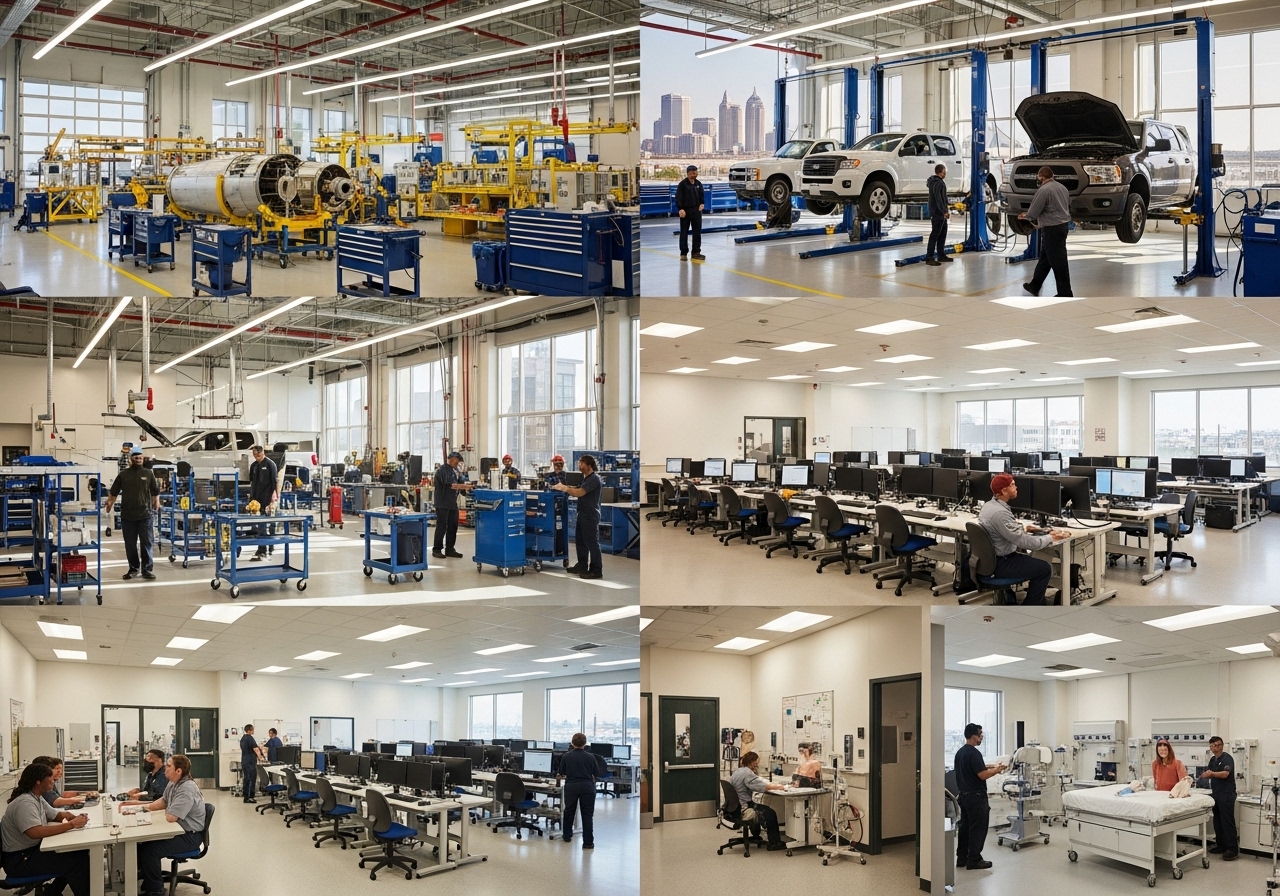
Community and technical colleges in the region routinely map course content to occupational standards. Programs in composites technology and aviation maintenance reflect manufacturer tolerances and quality protocols, while mechatronics and industrial automation curricula mirror what production floors demand. Health-related programs emphasize clinical hours and simulation labs to ensure competency in patient care and diagnostics.
Economic returns from technical education
Beyond individual outcomes, technical education generates measurable economic returns. In one illustrative analysis, a regional technical college was calculated to contribute more than a hundred million dollars annually to the local economy through operations, construction, student spending, and increased alumni productivity. For students and taxpayers, the return on investment commonly appears in higher lifetime earnings, increased tax receipts, and lower public costs from unemployment or welfare dependency.
Closing the skills gap
Rapid industry growth exposes talent shortages: employers report openings in advanced manufacturing, IT security, and allied-health professions that remain unfilled. Technical schools respond with short-term certificate offerings, co-op semesters, and employer-sponsored apprenticeships. These approaches compress the time to employment and reduce the friction of transitioning workers into new fields, including career changers and adult learners.
Collaborations that accelerate impact
The most resilient workforce strategies feature collaboration. Technical schools and employers co-design coursework, share lab equipment, and co-locate training near production facilities. These collaborations reduce onboarding time for employers and sharpen the practical training students receive.
Industry-partnership examples
– Aerospace and automotive firms often support curriculum development, donate tooling and equipment, and provide internship slots so students can work on real production issues.
– Tech companies contribute to cybersecurity labs, sponsor capstone projects, and advise on emerging vulnerabilities and tools.
– Health systems provide clinical placements and partner on simulation suites that replicate hospital workflows.
Such relationships create talent channels that are more predictable and aligned than traditional talent markets. They also give students visibility into employer expectations and workplace culture before graduation.
Challenges and practical opportunities
Technical schools face constraints that influence their ability to meet demand at scale. Recruiting and retaining instructors with current industry experience often competes directly with employer pay and schedules. Likewise, capital-intensive equipment—robotic cells, composite autoclaves, diagnostic imaging simulators—requires investment and maintenance.
Yet these challenges yield pragmatic opportunities. Virtual labs and remote-learning technologies extend access for working adults and rural students. Shared-use equipment consortia allow multiple institutions and employers to amortize the cost of advanced machinery. Expanded apprenticeship frameworks, supported by state or federal incentives, make paid on-the-job training more attractive for both employers and trainees.
Comparative snapshot: programs, credentials, and impact
| Industry | Representative Technical Programs | Typical Credential | Local Economic Role |
|---|---|---|---|
| Aerospace | Composites Technology, Aircraft Maintenance, Quality Inspection | Certificate / Associate of Applied Science | Supports assembly operations and supplier network; high demand for precision skills |
| Automotive Manufacturing | Mechatronics, Industrial Automation, Welding | Certificate / Diploma | Feeds production lines and maintenance teams; reduces downtime through skilled technicians |
| Information Technology | Cybersecurity, Cloud Operations, Software Development | Certificates, Associate Degrees, Vendor Certifications | Accelerates startup growth and supports corporate IT functions |
| Healthcare | Nursing, Medical Assisting, Radiologic Technology, Health Information | Diploma / Associate Degree | Fills clinical roles across hospitals and clinics; stabilizes frontline staffing |
Measuring success and sustaining momentum
Success is visible in employment placement rates, employer satisfaction, and economic multipliers. Placement rates that exceed regional averages signal alignment between training and job needs. Employer-led advisory boards and periodic curriculum reviews keep programs relevant. Public investment in training facilities often yields measurable returns in job creation and tax revenue.
Policymakers, educators, and employers can deepen impact by coordinating on three fronts: workforce pipeline planning, funding for high-cost equipment, and flexible credentialing that recognizes both classroom learning and supervised workplace experience. Apprenticeship expansions, for example, transform training costs into productive labor and give trainees wages while they learn.
Final thoughts
Charleston’s economic rise is not accidental; it is the product of strategic investment, geographic advantages, and a growing alignment between what employers need and what training institutions provide. Technical schools are more than educational providers—they are workforce architects, economic partners, and community stabilizers. As industries evolve, the schools’ ability to refresh curricula, scale equipment access, and maintain employer partnerships will determine how effectively the region turns opportunity into shared prosperity.
Key Takeaways
- Economic diversification in Charleston has created sustained demand for workers across aerospace, automotive, IT, and healthcare.
- Technical schools supply job-ready graduates through short-cycle credentials, apprenticeships, and employer-aligned curricula.
- Strengthened partnerships between educators and industry sharpen program relevance and accelerate placement into well-paying roles.
Frequently Asked Questions
How do technical schools differ from four-year colleges in Charleston?
Technical schools emphasize applied skills and shorter credential timelines tailored to specific occupations. Programs are typically focused on direct workforce entry—through certificates, diplomas, and associate degrees—rather than broad liberal-arts preparation, which makes time-to-employment faster for many technical fields.
Can employers influence the curriculum at technical colleges?
Yes. Employers often sit on advisory boards, sponsor lab equipment, and collaborate on course design. Those partnerships help ensure students learn tools, processes, and safety practices that match on-the-job realities.
What career areas have the fastest hiring needs in the region?
Aerospace technicians, mechatronics and automation technicians, cybersecurity analysts, and allied-health professionals such as nurses and medical technologists consistently show strong hiring demand due to growth in manufacturing, tech, and healthcare.
Are there financial supports for students pursuing technical training?
Students may access federal aid, state grants, employer-funded apprenticeships, and scholarship programs. Some employers cover tuition for workers in training programs that lead directly to in-house roles.
How do technical schools measure graduate success?
Common metrics include employment placement rates, median earnings after program completion, employer satisfaction surveys, and credential attainment rates. These indicators help institutions refine offerings and demonstrate return on investment.

Author: STAFF HERE CHARLESTON
The CHARLESTON STAFF WRITER represents the experienced team at HEREcharleston.com, your go-to source for actionable local news and information in Charleston, Charleston County, and beyond. Specializing in "news you can use," we cover essential topics like product reviews for personal and business needs, local business directories, politics, real estate trends, neighborhood insights, and state news affecting the area—with deep expertise drawn from years of dedicated reporting and strong community input, including local press releases and business updates. We deliver top reporting on high-value events such as the Spoleto Festival USA, Charleston Wine + Food Festival, and the MOJA Festival. Our coverage extends to key organizations like the Charleston Metro Chamber of Commerce and the Charleston Museum, plus leading businesses in tourism and maritime industries that power the local economy such as South Carolina Ports Authority and the Charleston Visitor Center. As part of the broader HERE network, including HEREaiken.com, HEREbeaufort.com, HEREchapin.com, HEREcharleston.com, HEREclinton.com, HEREcolumbia.com, HEREgeorgetown.com, HEREgreenwood.com, HEREgreenville.com, HEREhiltonhead.com, HEREirmo.com, HEREmyrtlebeach.com, HEREnewberry.com, HERErockhill.com, HEREspartanburg.com, HEREaustin.com, HEREcollegestation.com, HEREdallas.com, HEREhouston.com, and HEREsanantonio.com, we provide comprehensive, credible insights into South Carolina's dynamic landscape.