
Charleston, SC, August 18, 2025
Charleston: Comparing Public and Private Technical Schools in Charleston, SC
Charleston’s economy blends historic tourism, a growing tech sector, advanced manufacturing, and an expanding healthcare industry, and that mix shapes what learners seek from technical education. Choosing between public and private technical schools in Charleston matters because the path a student selects can affect cost, credential portability, time-to-employment, and long-term career flexibility. This article outlines the practical differences, offers concrete examples from institutions in the Charleston area, and provides guidance for making a choice that fits specific goals and life circumstances.
Public Technical Education: Structure, Scale, and Access
Public technical education in Charleston is represented most prominently by Trident Technical College (TTC). Formed in the early 1970s, TTC serves a broad population across multiple campuses, including the Thornley Campus in North Charleston and the Palmer Campus closer to downtown. The college delivers a wide assortment of associate degrees, diplomas, and short-term certificates covering fields from industrial technologies and construction to allied health and culinary arts. Enrollment figures for the college typically reach into the tens of thousands per academic year, reflecting its role as a major regional provider of workforce training and community education.
Public technical schools are often funded in part by state appropriations, which translates into lower tuition rates for in-district or in-state students compared with private alternatives. That affordability, combined with robust financial aid offices and access to federal student aid, makes public technical colleges attractive for students balancing cost and credentialing needs. Another hallmark of public institutions is the emphasis on transferability: many community and technical colleges maintain formal articulation agreements with four-year universities to help students move from an associate degree into a bachelor’s program without losing credits.
Beyond degree and certificate offerings, public technical schools in Charleston commonly operate adult education, workforce development, and continuing education units that collaborate with local employers to deliver customized training. This scale and public mandate often translate into more program variety—students who are unsure about a career path can explore multiple disciplines before committing.
Private Technical Schools: Specialization, Speed, and Industry Focus
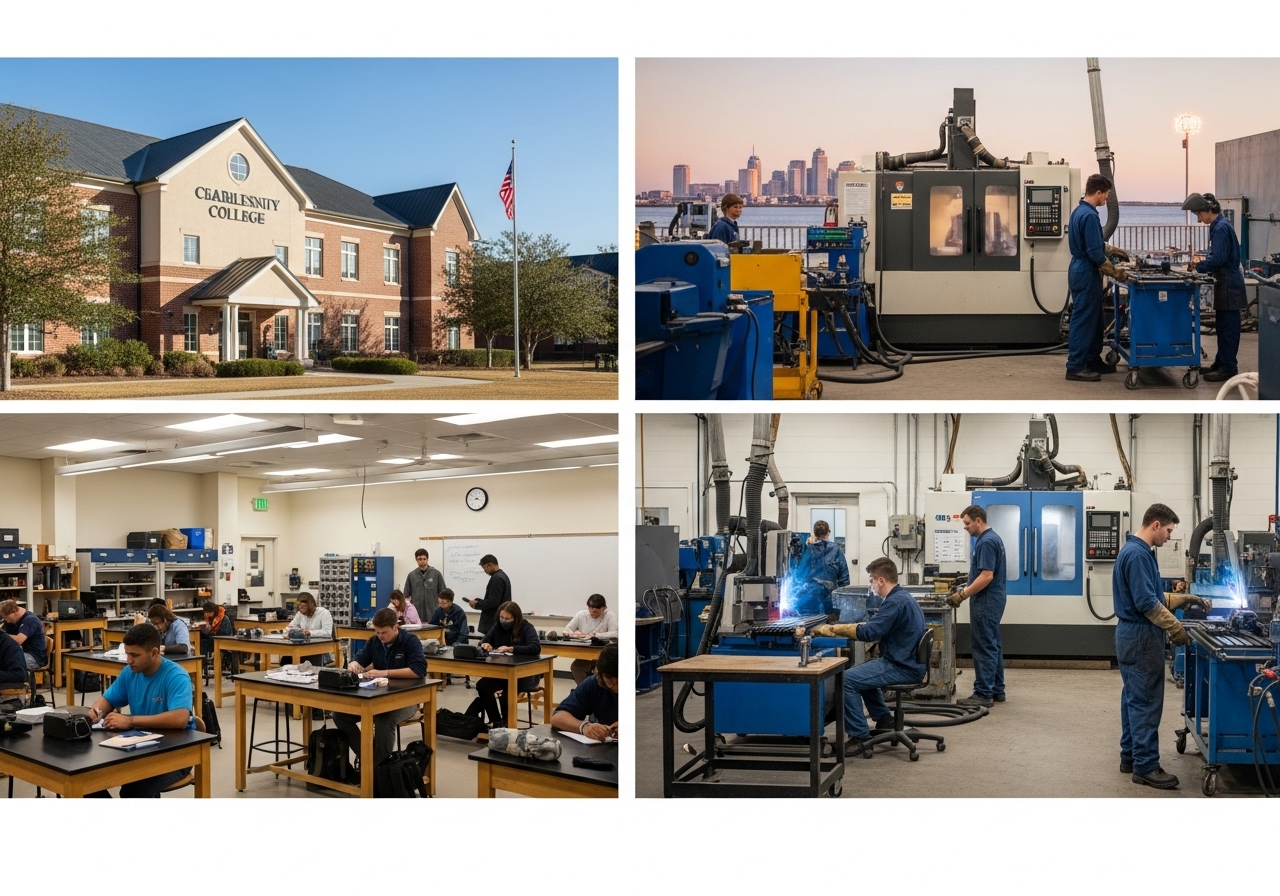
Private technical schools in the Charleston area tend to concentrate on specific trades and vocational niches. Institutions such as Southeastern College (with programs centered around healthcare professions) and local training providers like Palmetto Training (focusing on welding, CNC, and commercial driving) exemplify the private model: targeted, hands-on curricula designed to prepare students for particular occupations in a relatively short time frame.
Key advantages of private technical schools include flexible scheduling, compressed program lengths, and often smaller cohorts that allow for more individualized instructor attention. Those features appeal to career changers, adult learners, and people who need to complete training quickly to enter the workforce. Private providers frequently maintain direct lines to employers in their niche industries, which can boost opportunities for internships, apprenticeships, and job placement immediately after graduation.
Tuition at private technical schools is generally higher than at public counterparts, but many private institutions offer financing options, institutional scholarships, or payment plans that offset sticker price. Because private schools vary widely in size and governance, their credentials may range from industry certificates to diploma programs and rarely to regionally accredited associate degrees—making it important for prospective students to verify whether a program’s credential meets employer expectations or is eligible for financial aid.
Side-by-Side: What to Compare
Choosing between public and private technical schools requires looking beyond slogans and brochures. Consider the following comparisons that affect student outcomes and day-to-day experience.
| Decision Factor | Public Technical Schools (e.g., Trident Technical College) | Private Technical Schools (e.g., Southeastern College, Palmetto Training) |
|---|---|---|
| Cost | Typically lower tuition rates, state-supported; strong access to federal aid and grants. | Higher tuition on average; options may include institutional aid, scholarships, and employer-funded training. |
| Program Breadth | Wide selection across many industries—good for exploration and multi-path careers. | Focused programs tailored to specific trades or healthcare specialties. |
| Class Experience | Larger cohorts and multiple sections; variable instructor-to-student ratios. | Smaller classes, more one-on-one instruction, often more lab or shop time per student. |
| Accreditation & Credentials | Typically regionally accredited; credits usually transferable to four-year schools. | Accreditation varies; programmatic accreditation common in healthcare fields—verify before enrolling. |
| Industry Linkages | Partnerships with local employers, workforce boards, and apprenticeship programs. | Often direct employer relationships in niche markets; faster placement for job-ready skills. |
How to Evaluate Accreditation, Curriculum, and Outcomes
Accreditation is a practical filter: regional accreditation supports academic transfer and access to federal aid, while programmatic accreditation (for nursing, dental hygiene, radiography, etc.) certifies that a program meets professional standards. For example, a student interested in registered nursing should check whether a nursing program meets state board requirements and whether graduates are eligible to sit for licensure exams.
Curriculum quality can be gauged by reviewing course syllabi, lab and shop facilities, instructor credentials, and opportunities for experiential learning—clinical rotations, apprenticeships, and capstone projects. A visit to campus or a virtual tour can reveal whether machinery, labs, and simulation equipment mirror what actual employers use.
Outcome metrics such as graduation rates, job placement percentages, and licensure pass rates are informative, but they should be interpreted in context. Short-term certificate programs may have very different timelines and benchmarks than two-year associate programs. Ask institutions how they measure placement (employed in-field, enrolled in further education, or full-time employment) and whether employers in Charleston regularly recruit their graduates.
Financial Considerations and Return on Investment
Budgeting for technical education goes beyond listing tuition. Factor in books and supplies, tools or uniforms needed for trade programs, transportation between campuses or worksites, and potential lost wages during training. Public colleges tend to offer lower per-credit costs and wider access to grants and work-study programs, which helps reduce student debt. Private schools often emphasize accelerated pathways, so a higher monthly cost may still produce a favorable return if the time-to-hire is significantly shorter.
Prospective students should calculate an estimated cost-per-month of training and compare that with realistic starting wages for their chosen field in Charleston. Local labor market information, such as projected demand for healthcare technicians, skilled trades, or IT support, can help align program choice with employment opportunities.
Making a Decision that Fits Your Life
The right choice depends on a student’s priorities:
– If affordability, credit transferability, and access to a broad curriculum are primary concerns, a public technical college may be the better match.
– If rapid entry to a specific occupation, small cohort instruction, and flexible scheduling are top priorities, a private technical school may deliver faster results.
– If licensure or certification is required for the target occupation, verify programmatic accreditation and licensure pass rates before committing.
Practical steps before enrolling include attending information sessions, speaking with alumni or employers who hire graduates, checking program accreditation and state licensure alignment, calculating total program costs, and reviewing the school’s career services and placement support.
Find out whether the school offers night or weekend classes, employer-based training partnerships, internship opportunities, and career counseling. These operational details often make the difference between a certificate that leads to a job and one that becomes a sunk cost.
Key Takeaways
- Public technical schools
- Private technical schools
- Evaluate accreditation, program outcomes, scheduling flexibility, and total cost to determine which model aligns with your career objectives and financial situation.
FAQ
What questions should I ask when touring a technical school?
Ask about program accreditation, licensure pass rates where relevant, job placement statistics for graduates, the ratio of hands-on lab time to lecture, opportunities for internships or apprenticeships, tuition and additional costs, financial aid options, and whether credits transfer to four-year institutions.
Can I transfer credits from a technical college to a university?
Many public technical colleges maintain articulation agreements with regional universities that allow transfer of associate-level credits toward a bachelor’s degree. Transferability depends on accreditation and specific course equivalencies, so obtain written agreements or transfer guides before enrolling.
How long do programs typically take at private technical schools?
Private technical programs vary widely, but many certificate and diploma offerings are designed to be completed in a few months to a year. Accelerated formats and evening classes can shorten calendar time to completion, but verify the program schedule and total contact hours.
Are job placement services available for graduates?
Most technical schools provide career services such as resume workshops, interview prep, job fairs, and employer connections. The depth of placement assistance varies, and some private schools have stronger industry pipelines in specific fields. Ask for recent employer partners and placement outcomes.
How do I know if a credential is recognized by employers in Charleston?
Check whether the program aligns with state licensure requirements, inquire about employers who hire program graduates, and consult local labor market resources such as the South Carolina Department of Employment or regional workforce boards to verify demand for specific credentials.

Author: STAFF HERE CHARLESTON
The CHARLESTON STAFF WRITER represents the experienced team at HEREcharleston.com, your go-to source for actionable local news and information in Charleston, Charleston County, and beyond. Specializing in "news you can use," we cover essential topics like product reviews for personal and business needs, local business directories, politics, real estate trends, neighborhood insights, and state news affecting the area—with deep expertise drawn from years of dedicated reporting and strong community input, including local press releases and business updates. We deliver top reporting on high-value events such as the Spoleto Festival USA, Charleston Wine + Food Festival, and the MOJA Festival. Our coverage extends to key organizations like the Charleston Metro Chamber of Commerce and the Charleston Museum, plus leading businesses in tourism and maritime industries that power the local economy such as South Carolina Ports Authority and the Charleston Visitor Center. As part of the broader HERE network, including HEREaiken.com, HEREbeaufort.com, HEREchapin.com, HEREcharleston.com, HEREclinton.com, HEREcolumbia.com, HEREgeorgetown.com, HEREgreenwood.com, HEREgreenville.com, HEREhiltonhead.com, HEREirmo.com, HEREmyrtlebeach.com, HEREnewberry.com, HERErockhill.com, HEREspartanburg.com, HEREaustin.com, HEREcollegestation.com, HEREdallas.com, HEREhouston.com, and HEREsanantonio.com, we provide comprehensive, credible insights into South Carolina's dynamic landscape.