

Charleston, South Carolina, August 30, 2025
Charleston, South Carolina: Programs and Clinics Available at Charleston School of Law
The Charleston School of Law presents a mix of classroom rigor and hands-on practice aimed at preparing students for multiple legal pathways. Located in a city with a deep legal and maritime history, the school structures its curriculum to combine doctrinal study with practical skill-building, community service, and career preparation. The campus organizes its offerings around a core Juris Doctor program, a variety of experiential learning options, focused advocacy centers, and resources to help graduates enter the profession.
Juris Doctor (J.D.) Program
The Juris Doctor (J.D.) remains the centerpiece of the school’s academic portfolio. Students may enroll on a full-time track, typically completed in three years, or choose a part-time path that spreads the coursework across four years. The degree plan integrates foundational courses in contracts, torts, civil procedure, property, constitutional law, criminal law, and professional responsibility with elective opportunities tied to local practice specialties.
Beyond required classes, degree candidates must satisfy several non-classroom components designed to promote professional development and community engagement. Those elements include a minimum of 50 hours of pro bono legal service, participation in professional identity formation sessions, and completion of experiential coursework such as clinics or externships. These requirements reflect a broader effort to produce lawyers who understand both legal doctrine and the ethical, civic dimensions of practice.
Experiential Learning Opportunities
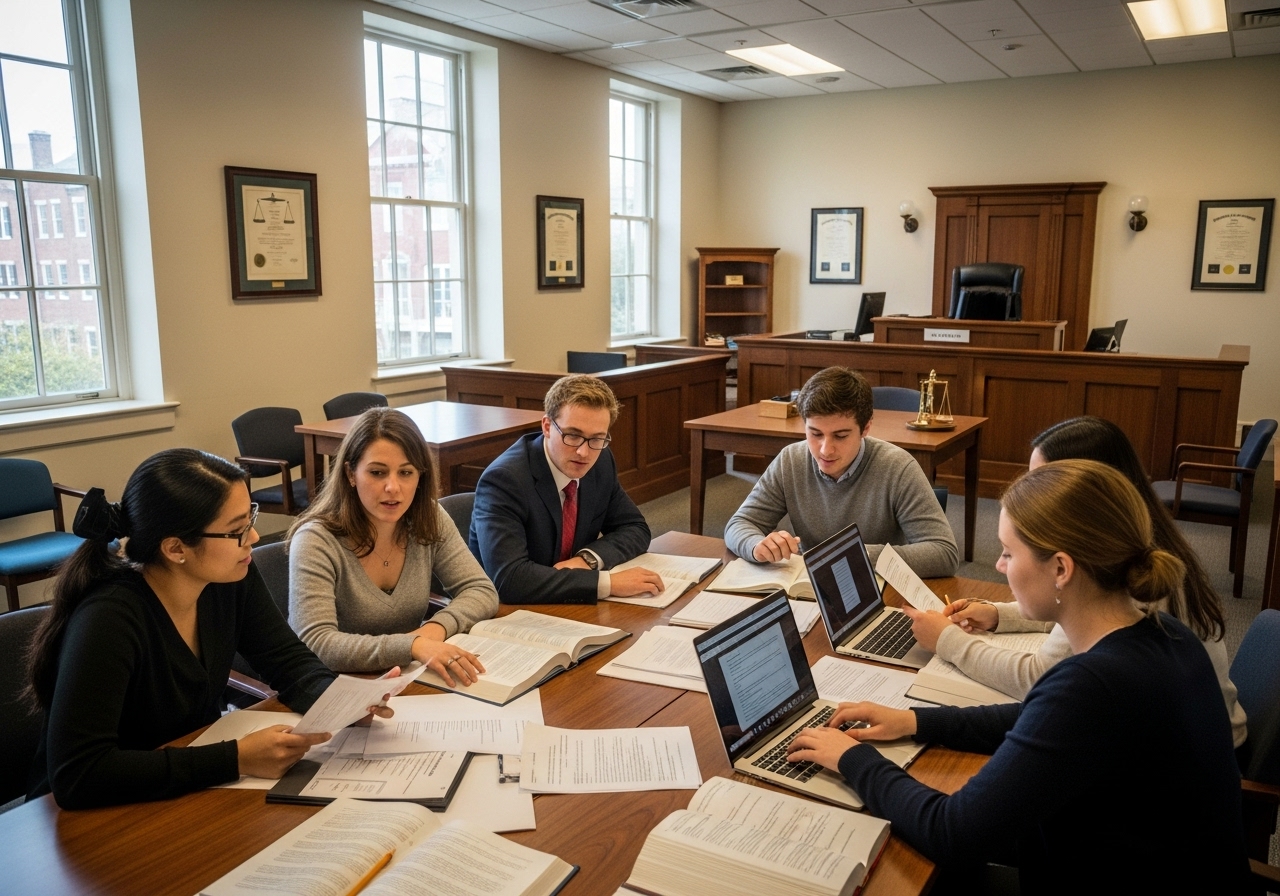
To sharpen practical skills, the school emphasizes experiential learning across clinics, externships, simulation courses, and advocacy programs. The objective is to reduce the gap between legal theory taught in the classroom and the procedural, investigative, and client-care demands of actual practice.
Clinics
Clinical programs connect students with community organizations and provide supervised representation for clients who might otherwise lack access to legal services. Clinic work gives students responsibility for case intake, legal research, drafting pleadings, and courtroom appearances under faculty supervision. These placements frequently focus on areas such as family law, housing and landlord-tenant disputes, public benefits and social services, and community outreach projects that address local legal needs.
Because clinics involve direct client contact and real-world consequences, they are carefully staged to reflect a balance between student learning and competent legal service. Students leave clinics with sharpened client communication abilities, courtroom experience, and a better sense of case management.
Externships
Externships expand the range of practical settings where students can earn academic credit while working under the supervision of practicing attorneys or judges. Host sites include state and federal courts, government agencies, public defender and prosecutor offices, and private law firms. The externship program is structured to ensure meaningful legal tasks rather than clerical work; students typically perform legal research, draft memos and briefs, assist with hearings, and observe or participate in negotiations and trials.
Externship placements also function as professional pipelines: many students secure post-graduate employment or clerkships through relationships formed during these placements.
Pro Bono Program
Public service is an explicit element of the school’s educational philosophy. The mandatory pro bono requirement encourages students to apply classroom knowledge to benefit underserved populations. Completing 50 pro bono hours helps students develop a habit of civic involvement and exposes them to practice areas they might not otherwise encounter in elective coursework.
The program coordinates with local legal aid organizations, nonprofit groups, and community clinics to match student volunteers with meaningful tasks. These experiences can include client intake, document preparation, legal education workshops, and supervised representation in administrative or lower-court matters.
Advocacy Programs
For students drawn to courtroom work or dispute resolution, the school offers several dedicated advocacy platforms that emphasize litigating, negotiating, and appellate reasoning.
Center for Trial Advocacy
The Center for Trial Advocacy focuses on the practical mechanics of trial work. It provides mock trial simulations, witness interviewing exercises, and opportunities to refine examination techniques. The center serves a dual role: it is both a training ground for students and a continuing-education resource for alumni and local attorneys seeking to maintain or enhance trial competencies.
Center for Business and Transactional Law
Not every dispute is resolved in court; many matters are resolved through contracts, corporate structuring, and transactional counsel. The Center for Business and Transactional Law offers coursework and workshops that take students from basic contract drafting to more complex corporate and transactional practice. Students interested in corporate law, real estate, or commercial finance can gain practical skills for drafting agreements, conducting due diligence, and understanding regulatory compliance issues.
Moot Court and Advocacy Competitions
The Moot Court program encourages persuasive writing and oral argument through practice rounds and interschool competitions. Participation develops appellate advocacy skills, helps students think on their feet, and often includes national-level contest opportunities that strengthen resumes and professional networks.
Career Services
The Career Services office provides individualized counseling, résumé and cover letter review, mock interviews, and targeted employer outreach. It organizes on-campus interview programs, career panels, and networking events to connect students with law firms, public interest organizations, corporate legal departments, and government employers. The office also maintains resources for bar exam preparation and tracks employment outcomes to inform students’ job-search strategies.
Publications and Scholarly Outlets
Academic publishing at the school supports legal scholarship, debate, and student involvement in editing and research. Student-run journals provide platforms for discussion in areas such as maritime law — an area of local relevance — alternative dispute resolution, and broad legal analysis. Participation in journal work hones legal writing, citation mastery, and critical editing skills that are prized by employers.
Comparing Program Features
| Program Component | Primary Purpose | Typical Student Outcome |
|---|---|---|
| Full-time J.D. | Accelerated doctrinal study and campus involvement | Degree completion in about 3 years with internship/clinic opportunities |
| Part-time J.D. | Flexible scheduling for working students | Degree completion in about 4 years while maintaining employment |
| Clinics | Supervised client representation and casework | Hands-on experience, courtroom exposure, enhanced client skills |
| Externships | Legal work in professional settings with academic credit | Practical tasks, networking, potential job leads |
| Pro Bono | Community service and professional responsibility | At least 50 hours of service, civic engagement habits |
How These Elements Work Together
A student’s path often blends several components: doctrinal coursework sets the foundation, clinics and externships convert theory into practice, advocacy programs sharpen courtroom and negotiation skills, and career services translate experience into employment. This layered approach encourages adaptability; graduates who have tried multiple experiential settings tend to report greater confidence when they begin practicing.
Faculty supervision and structured reflection are vital parts of experiential pedagogy. Supervisors provide corrective feedback and scaffolded responsibility so students can advance from observation to independent tasks in a controlled way. That progression reduces risk to clients while maximizing educational benefits.
Key Takeaways
- The Charleston School of Law offers a flexible J.D. program with full-time and part-time tracks suited to different student needs.
- Practical training is emphasized through clinics, externships, a mandatory 50-hour pro bono service requirement, and several advocacy centers.
- Career services, student publications, and advocacy competitions work together to prepare students for professional life and specialized legal fields.
Frequently Asked Questions
What is the duration of the J.D. program?
The full-time J.D. path typically runs three years, while the part-time option is designed to be completed in about four years, allowing students to balance employment or other commitments.
How many pro bono hours are required before graduation?
Students must complete a minimum of 50 hours of pro bono legal service as part of their graduation requirements.
Can students earn academic credit for externships?
Yes. The externship program is structured so that students can receive academic credit while engaging in substantial legal work under the supervision of practicing attorneys or judges.
What types of clinics are available?
Clinics connect students with community organizations and typically address needs such as family law matters, housing and tenant issues, public benefits, and other community-based legal services. Clinic offerings may shift based on community demand and faculty expertise.
Does the school provide support for job placement?
Career Services offers individualized counseling, interview preparation, on-campus interviews, and networking events designed to help students transition into legal employment across public, private, and nonprofit sectors.

Author: STAFF HERE CHARLESTON
The CHARLESTON STAFF WRITER represents the experienced team at HEREcharleston.com, your go-to source for actionable local news and information in Charleston, Charleston County, and beyond. Specializing in "news you can use," we cover essential topics like product reviews for personal and business needs, local business directories, politics, real estate trends, neighborhood insights, and state news affecting the area—with deep expertise drawn from years of dedicated reporting and strong community input, including local press releases and business updates. We deliver top reporting on high-value events such as the Spoleto Festival USA, Charleston Wine + Food Festival, and the MOJA Festival. Our coverage extends to key organizations like the Charleston Metro Chamber of Commerce and the Charleston Museum, plus leading businesses in tourism and maritime industries that power the local economy such as South Carolina Ports Authority and the Charleston Visitor Center. As part of the broader HERE network, including HEREaiken.com, HEREbeaufort.com, HEREchapin.com, HEREcharleston.com, HEREclinton.com, HEREcolumbia.com, HEREgeorgetown.com, HEREgreenwood.com, HEREgreenville.com, HEREhiltonhead.com, HEREirmo.com, HEREmyrtlebeach.com, HEREnewberry.com, HERErockhill.com, HEREspartanburg.com, HEREaustin.com, HEREcollegestation.com, HEREdallas.com, HEREhouston.com, and HEREsanantonio.com, we provide comprehensive, credible insights into South Carolina's dynamic landscape.