

Charleston, South Carolina, August 20, 2025
Charleston Technical Schools: Career Paths and Next Steps
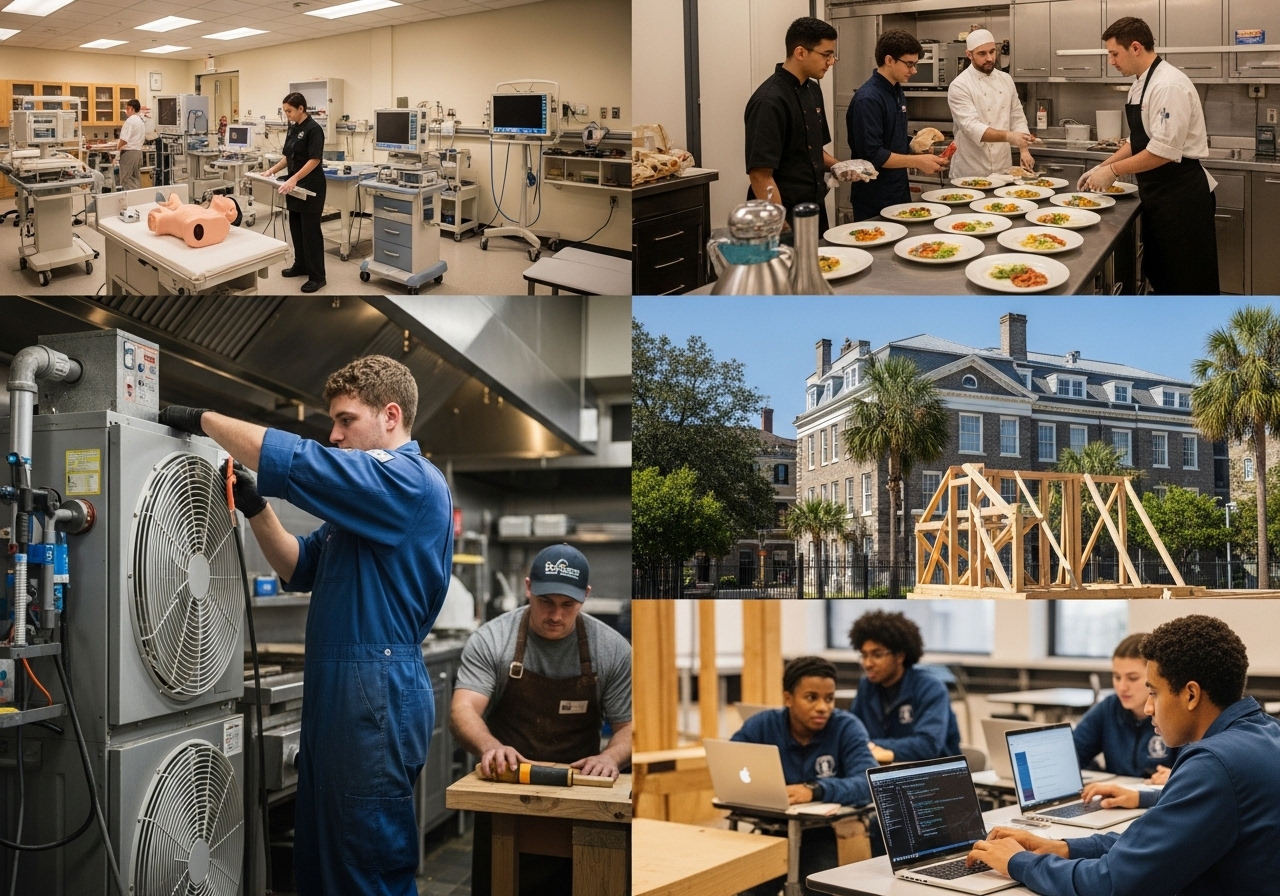
Charleston sits at the intersection of historic preservation, a booming hospitality scene, expanding healthcare systems, and growing ports and manufacturing facilities. That mix makes the city an ideal place to attend a technical school and move quickly into the workforce. Local institutions such as Trident Technical College, the American College of the Building Arts, and culinary training centers provide applied instruction that connects directly to employers across the region.
Healthcare Professions: Fast routes into a stable sector
Programs in medical assisting, practical nursing, surgical technology, and pharmacy technology dominate technical-college catalogs because healthcare continues to generate steady demand for trained support staff. Many entry-level health positions require focused, hands-on training rather than a four-year degree, and graduates are often eligible for state certification or licensure exams that expedite employment. Local health systems, large and small clinics, and outpatient centers create a near-constant need for competent, credentialed staff.
Graduates from these pathways typically follow structured career ladders: starting as a certified assistant or technician, gaining experience, and then pursuing additional credentials or transfer options to move into higher-paying clinical roles. Colleges frequently maintain partnerships with regional hospitals and clinics to place students into clinical rotations that lead directly to hire-on opportunities.
Information Technology: Practical skills that transfer across industries
Technical programs in networking, systems administration, cybersecurity fundamentals, and applied programming address skills employers want immediately. Shorter credential programs—certificates that can be completed in months rather than years—allow students to enter roles such as help-desk analyst, junior systems administrator, or information security technician. Because digital infrastructure touches finance, healthcare, hospitality, and local government, IT graduates enjoy a range of potential employers.
Many IT programs emphasize industry certifications (for example, vendor-neutral options) alongside portfolio projects. Those tangible outputs—network diagrams, security assessments, or small applications—help graduates stand out in hiring processes, particularly when backed by apprenticeship placements or internships with local firms.
Culinary Arts and Hospitality: Leveraging Charleston’s food and tourism economy
Charleston’s national reputation for cuisine and tourism supports robust training programs in culinary arts, baking and pastry, and hospitality management. Students receive hands-on practice in professional kitchens, front-of-house operations, and event management. The region’s restaurants, boutique hotels, and resort properties offer internships and employment that can quickly translate classroom skills into paid work.
Culinary graduates often move into roles as line cooks, sous chefs, or pastry specialists, with management opportunities arising for those who combine culinary skill with business training. For many culinary students, entrepreneurship—opening a small food business or catering service—becomes a viable next step after gaining practical experience.
Skilled Trades: Tradespeople in short supply
Programs in welding, automotive technology, HVACR (heating, ventilation, air conditioning, and refrigeration), and electrical technology remain central to technical colleges. These fields emphasize hands-on competencies, safety practices, and nationally recognized certifications that are portable across regions. Local construction, manufacturing, and maritime businesses seek technicians who can perform immediately on job sites, and that demand traditionally translates to strong starting wages compared with other entry-level roles.
Apprenticeships and employer-sponsored training programs are common in the trades, enabling students to earn while they learn. The presence of manufacturing and shipbuilding facilities in the Charleston area provides additional employment pathways for graduates who pursue specialized mechanical and welding credentials.
Building Arts: Preserving a unique architectural legacy
Unique to the region, the building arts programs focus on conservation, historic carpentry, plasterwork, masonry, and traditional metalworking. Graduates of these programs find work with preservation firms, craft studios, custom home builders, and public restoration initiatives. Given Charleston’s historic fabric, there is ongoing work that requires craftsmen familiar with period techniques and materials.
Training in this area blends artistic craft with technical precision and often leads to niche careers where reputation and demonstrated skill command higher compensation for specialized projects.
Business, Administration, and Entrepreneurship: Skills that support any industry
Two-year programs and certificates in business administration, accounting fundamentals, and digital marketing supply essential administrative and managerial competencies. Graduates can enter positions as office managers, billing specialists, or junior marketing coordinators. When combined with industry-specific technical training, business coursework helps graduates move into supervisory roles faster.
Technical education also supports entrepreneurship. The combination of practical trade skills and business fundamentals means many graduates launch small businesses—landscaping, food service, repair shops, or independent consulting—contributing directly to the local economy.
Education and Training: Building the next generation of workers
Programs in early childhood education and teacher assisting prepare students for immediate roles in preschools, daycare centers, and after-school programs. These pathways emphasize child development, classroom management basics, and state certification requirements. Graduates who continue toward additional credentials can move into higher-level teaching roles or administration.
Transfer Opportunities: A bridge to four-year degrees
Many technical colleges maintain articulation agreements with four-year institutions, enabling students to transfer credits toward bachelor’s degrees in nursing, business, engineering technology, or the arts. These agreements provide a cost-effective route for students who want the accelerated career entry of a technical credential but also plan to pursue expanded qualifications later.
Because transfer pathways are negotiated between institutions, students should consult academic advisors early to align their technical coursework with the requirements of prospective transfer schools.
How employers and the community benefit
When graduates enter the workforce quickly, employers fill hard-to-staff roles and community services expand. Technical-school alumni populate essential positions that underpin healthcare delivery, maintain regional infrastructure, and support tourism—sectors that collectively sustain the local economy. Beyond immediate employment, trained graduates often participate in civic life, start small businesses, and mentor the next cohort of students.
| Program Area | Typical Length | Common Entry-Level Role | Usual Starting Salary Range (approx.) |
|---|---|---|---|
| Practical Nursing / Medical Assisting | 9–24 months | Medical assistant, LPN | $30,000–$55,000 |
| Information Technology / Cybersecurity | 6–18 months | Help-desk analyst, junior sysadmin | $35,000–$65,000 |
| Culinary Arts / Hospitality | 9–24 months | Line cook, banquet manager | $25,000–$55,000 |
| Welding / HVAC / Automotive | 6–24 months | Welder, HVAC tech, automotive tech | $35,000–$65,000 |
| Building Arts / Restoration | 1–4 years | Conservator, carpenter, stoneworker | $30,000–$70,000+ |
| Business / Administrative Support | 6–24 months | Office manager, billing specialist | $30,000–$55,000 |
Maximizing value from technical education
Students extract the most benefit when they pair technical instruction with work-based experiences. That means pursuing internships, apprenticeships, or cooperative programs; building a professional portfolio; and securing industry-recognized certifications where applicable. Career services at technical schools often provide resume workshops, interview practice, and employer networking events that shorten the time between graduation and gainful employment.
Another practical step is mapping short-term credentials to long-term goals. A student might begin with a certificate to enter the workforce quickly, then use employer tuition assistance or transfer pathways to pursue advanced studies later. This staged approach balances income generation with professional advancement.
Local employers and sectors that hire technical-school grads
The Charleston area supports a diverse employer base—medical centers and specialty clinics, restaurants and hotel chains, construction and maritime firms, and a growing tech services sector. This diversity helps graduates shift between industries if they develop complementary skills. For example, an HVAC technician with business coursework can move into contracting and eventually lead a service firm.
Key Takeaways
- Technical programs enable quick entry into in-demand careers across healthcare, IT, trades, culinary, and preservation sectors.
- Work-based learning and certifications significantly improve hireability and early-career earnings.
- Transfer agreements offer flexibility for students who wish to convert technical credentials into four-year degrees later on.
Frequently Asked Questions
What types of credentials can I earn at a Charleston technical school?
Programs typically award certificates, diplomas, and associate degrees. Certificates are short and skill-focused, diplomas provide broader technical preparation, and associate degrees combine occupational training with general education courses that support transfer to four-year institutions.
How long does it take to start working after graduation?
Many certificate programs can be completed in six months to a year, allowing graduates to enter the workforce rapidly. Associate degrees usually take two years. Placement timelines depend on the field, licensing requirements, and whether the student completes internships or clinical rotations before finishing the program.
Do technical colleges help with job placement?
Most technical colleges offer career services that include job fairs, employer partnerships, resume assistance, and interview coaching. Apprenticeship programs and clinical placements often lead to direct hires, particularly in healthcare and skilled trades.
Are there options to continue my education after a technical program?
Yes. Many technical colleges have transfer agreements with four-year universities, allowing credits to carry forward toward bachelor’s degrees in related fields such as nursing, business, or engineering technology.
Can I start my own business after a technical program?
Graduates frequently launch small enterprises—repair services, catering, construction subcontracting, and specialty crafts—especially when they combine trade skills with entrepreneurship coursework or business certificates.

Author: STAFF HERE CHARLESTON
The CHARLESTON STAFF WRITER represents the experienced team at HEREcharleston.com, your go-to source for actionable local news and information in Charleston, Charleston County, and beyond. Specializing in "news you can use," we cover essential topics like product reviews for personal and business needs, local business directories, politics, real estate trends, neighborhood insights, and state news affecting the area—with deep expertise drawn from years of dedicated reporting and strong community input, including local press releases and business updates. We deliver top reporting on high-value events such as the Spoleto Festival USA, Charleston Wine + Food Festival, and the MOJA Festival. Our coverage extends to key organizations like the Charleston Metro Chamber of Commerce and the Charleston Museum, plus leading businesses in tourism and maritime industries that power the local economy such as South Carolina Ports Authority and the Charleston Visitor Center. As part of the broader HERE network, including HEREaiken.com, HEREbeaufort.com, HEREchapin.com, HEREcharleston.com, HEREclinton.com, HEREcolumbia.com, HEREgeorgetown.com, HEREgreenwood.com, HEREgreenville.com, HEREhiltonhead.com, HEREirmo.com, HEREmyrtlebeach.com, HEREnewberry.com, HERErockhill.com, HEREspartanburg.com, HEREaustin.com, HEREcollegestation.com, HEREdallas.com, HEREhouston.com, and HEREsanantonio.com, we provide comprehensive, credible insights into South Carolina's dynamic landscape.