
Charleston, South Carolina, August 18, 2025
Charleston and the Role of Technical Education
Charleston sits at the intersection of historic port activity, expanding technology hubs, and a diversified services economy. That combination creates steady demand for practical skills and job-ready graduates. Technical schools in and around Charleston respond to that demand by shaping programs expressly designed to move students from classrooms into careers with minimal friction.
How Technical Schools Define “Workforce-Ready”
Workforce readiness at Charleston’s technical institutions goes beyond textbook knowledge. These schools emphasize applied skills, industry alignment, and measurable outcomes. Administrators and faculty design curricula with employer needs in mind, then layer in hands-on training so students can perform on day one in a new role. That approach shortens the time between graduation and productive employment, and it keeps employers returning to the same talent pipeline.
Curriculum Built Around Local Needs
Program offerings reflect the region’s economic profile. Aviation maintenance, manufacturing technologies, maritime logistics, healthcare allied professions, welding, information technology, and culinary arts appear prominently on course lists. Programs are frequently reviewed and revised after consultations with employer advisory councils to ensure the skills taught match current job requirements.
Stackable Credentials and Short-Term Certifications
Technical schools use a modular credential structure that allows students to earn certificates, diplomas, and associate degrees in a progressive sequence. Smaller credentials provide quick entry into employment, while stacks add up to higher qualifications. This structure suits working adults, dislocated workers, and students who need to balance education with other responsibilities.
Hands-On Training That Mirrors Workplace Conditions
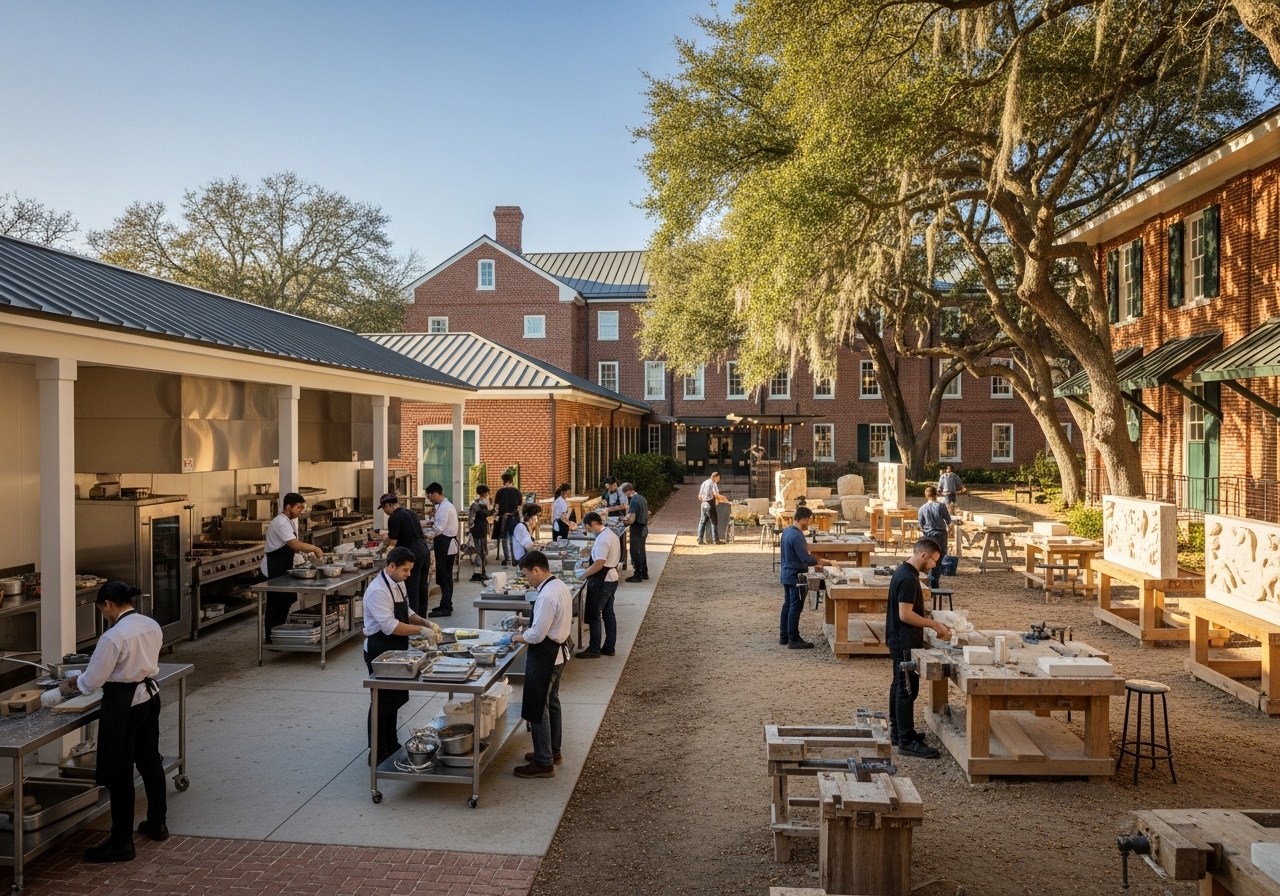
One consistent trait at Charleston-area technical schools is substantial investment in simulated and real-world learning environments. A few examples of the learning settings students encounter:
- High-fidelity labs for electrical, HVAC, and manufacturing that use the same equipment found in industry shops.
- Clinical placements and simulation suites for nursing and allied health that follow hospital protocols.
- Logistics and supply chain labs that replicate port operations and warehouse management systems.
- IT and cybersecurity war rooms that expose students to live scenarios and incident response tools.
These controlled environments allow repetition, error, and improvement without the high stakes of an actual workplace, so graduates enter jobs both confident and competent.
Apprenticeships, Co-ops, and Work-Based Learning
Work-based learning forms a bridge between campus and employer. Apprenticeship programs in mechanical trades and aerospace maintenance connect classroom theory with supervised on-the-job experience. Cooperative education placements and paid internships give students extended exposure to company cultures and workflows, and often lead directly to full-time offers. Employers benefit by evaluating talent in situ and tailoring training for their operations.
Employer Partnerships and Advisory Structures
Technical schools cultivate formal partnerships with employers across Charleston’s key sectors. Advisory boards composed of workforce leaders review program content and suggest new course offerings. For example, manufacturing employers help design mechatronics modules that reflect automated production lines, while healthcare systems inform patient-care lab scenarios and clinical competencies.
These partnerships extend beyond curriculum advice. Employers frequently donate equipment, fund scholarships, host site visits, provide guest instructors, and participate in job fairs. That practical engagement reduces mismatch between what students learn and what employers need.
Career Services, Placement Support, and Labor Market Alignment
Career centers at technical schools provide services tailored to an applied-studies student population. Resume workshops focus on technical project descriptions and credential lists. Mock interviews simulate trade-specific hiring processes. Schools also maintain active job boards and coordinate on-campus recruiting with local employers.
Labor market data informs program planning. Schools track regional employment trends and use that information to prioritize certain programs or expand capacity in high-demand areas. By aligning enrollments with employer demand, institutions improve the likelihood that a graduate will find employment in their field within months of program completion.
Flexible Delivery and Adult Learner Support
Charleston’s technical colleges adapt to adult learners and nontraditional students through flexible scheduling and multiple delivery modes. Night classes, hybrid formats, and condensed certificate cohorts allow individuals already working or managing family obligations to pursue training.
Support services further reduce barriers: tutoring centers, financial aid advising, childcare referrals, transportation assistance, and career coaching help students persist and graduate. For many adults, these wraparound services make the difference between entering a program and completing one.
Funding, Grants, and Economic Development Partnerships
State and federal workforce grants often subsidize short-term training initiatives that target in-demand occupations. Technical schools frequently administer grant-funded programs that offer tuition assistance, job placement bonuses, and employer-driven upskilling for incumbent workers. Economic development agencies sometimes co-invest in training to ensure a ready pipeline for new or expanding employers, particularly in manufacturing and advanced logistics.
Measurable Outcomes and Continuous Improvement
Performance metrics help institutions know whether their strategies work. Common indicators include program completion rates, credential attainment, job placement within the field, and employer satisfaction. Schools analyze these metrics and make changes where outcomes lag—adjusting syllabi, expanding lab hours, or forging new industry relationships.
Alumni follow-up also reveals strengths and gaps. Graduate employment surveys identify whether particular skills are lacking in the marketplace, prompting curricular revisions. Because of this feedback loop, programs tend to evolve quickly in response to real-world requirements.
Examples of Program Areas and Workforce Connections
To illustrate how these mechanisms translate into specific career pathways, consider a few program-to-industry alignments common in Charleston:
- Aircraft maintenance programs align with local aerospace facilities, offering apprenticeships and direct-hire pipelines.
- Healthcare technician training coordinates clinical rotations with regional hospitals, enabling quick transition into entry-level clinical roles.
- Welding and fabrication programs working with shipyards and manufacturers produce candidates for immediate hire in production and repair shops.
- Information technology and cybersecurity courses partner with regional tech employers for internships and hands-on security exercises.
Comparison Table: Program Types and Typical Outcomes
| Program Area | Typical Credential | Average Program Length | Common Employer Types | Short-Term Outcome |
|---|---|---|---|---|
| Aircraft Maintenance | Certificate / Associate | 12–24 months | Aerospace firms, MRO shops | Entry-level maintenance technician |
| Healthcare Allied | Certificate / Diploma | 6–18 months | Hospitals, clinics, long-term care | Clinical technician, support staff |
| Manufacturing & Mechatronics | Certificate / Associate | 9–24 months | Manufacturers, shipyards | Technician, production operator |
| Information Technology | Certificate / Associate | 6–18 months | IT firms, corporate IT departments | Help-desk, junior sysadmin, cybersecurity analyst |
Challenges and Areas of Focus
Technical institutions face persistent challenges: keeping equipment current, recruiting faculty with industry experience, and scaling programs fast enough to meet sudden employer demand. Workforce mobility and fluctuating industry cycles also complicate planning. To address these issues, schools prioritize continuous employer engagement, pursue public-private funding, and implement flexible program models that can expand or contract based on labor market signals.
Another important focus is equity. Ensuring that underrepresented groups and economically disadvantaged students can access training and job-placement resources remains a strategic priority. Programs that include targeted outreach, financial assistance, and mentorship increase participation and improve community-wide economic resilience.
How Students Experience the Transition
From the student perspective, the pathway from enrollment to employment often follows a consistent arc: orientation and skills assessment, hands-on coursework and lab practice, work-based learning placements, and targeted career services. That progression reduces uncertainty and provides checkpoints where students can adjust plans, obtain additional support, or accelerate into employment.
Employers report that graduates arrive with practical experience, documented credentials, and the soft skills necessary to succeed in team-based, production, or client-facing environments. For many students, the immediate payoff is measurable: stable employment, wage growth, and opportunities for continued education and career advancement.
Looking Ahead
As Charleston’s economy evolves, technical schools will continue to adapt, using employer feedback and labor market data to guide program development. Emerging areas such as electric vehicle maintenance, advanced manufacturing automation, and maritime renewable-energy installation are likely to shape future course offerings. The steady thread remains the same: aligning training with employer needs and giving students the practical tools to succeed.
Key Takeaways
- Charleston’s technical institutions emphasize hands-on training, employer partnerships, and stackable credentials to create job-ready graduates.
- Programs align with local industry needs—aviation, healthcare, manufacturing, logistics, and IT—supported by apprenticeships and clinical placements.
- Flexible delivery, career services, and continuous employer feedback help students transition quickly into sustainable employment.
Technical schools in Charleston do more than teach; they connect education to employment through tangible, employer-driven strategies that equip learners for immediate contribution and long-term career mobility.

Author: STAFF HERE CHARLESTON
The CHARLESTON STAFF WRITER represents the experienced team at HEREcharleston.com, your go-to source for actionable local news and information in Charleston, Charleston County, and beyond. Specializing in "news you can use," we cover essential topics like product reviews for personal and business needs, local business directories, politics, real estate trends, neighborhood insights, and state news affecting the area—with deep expertise drawn from years of dedicated reporting and strong community input, including local press releases and business updates. We deliver top reporting on high-value events such as the Spoleto Festival USA, Charleston Wine + Food Festival, and the MOJA Festival. Our coverage extends to key organizations like the Charleston Metro Chamber of Commerce and the Charleston Museum, plus leading businesses in tourism and maritime industries that power the local economy such as South Carolina Ports Authority and the Charleston Visitor Center. As part of the broader HERE network, including HEREaiken.com, HEREbeaufort.com, HEREchapin.com, HEREcharleston.com, HEREclinton.com, HEREcolumbia.com, HEREgeorgetown.com, HEREgreenwood.com, HEREgreenville.com, HEREhiltonhead.com, HEREirmo.com, HEREmyrtlebeach.com, HEREnewberry.com, HERErockhill.com, HEREspartanburg.com, HEREaustin.com, HEREcollegestation.com, HEREdallas.com, HEREhouston.com, and HEREsanantonio.com, we provide comprehensive, credible insights into South Carolina's dynamic landscape.